Creators
Rojony Khatun Author
Rojony Khatun
CalculatorToolsProjectExpert
Reviewers
Małgorzata Koperska, MD Steven Wooding
Last updated: January 14, 2026

DC Voltage Regulator Circuit Using IRF840 MOSFET

🇺🇸
English
Default
🇪🇸
Español
Spanish
🇫🇷
Français
French
🇩🇪
Deutsch
German
Push Button Switch

Push Button Switch

A simple mechanical switch used to make or break a circuit when pressed. It returns to its original position once released. Commonly used in doorbells, calculators, reset buttons, and control panels.

2m Fixed Resistor 1/4W

2M Fixed Resistor 1/4W

A 2 Megaohm fixed resistor with a ¼ Watt power rating, used for limiting current, voltage division, biasing circuits, and signal conditioning in electronic applications.

IRF840 MOSFET

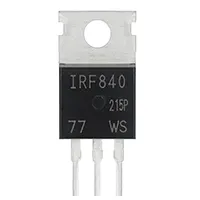
IRF840 MOSFET

An N-channel power MOSFET with 500V drain-to-source voltage and 8A current capacity, commonly used in SMPS, inverters, power supplies, and motor control circuits.

*Please note: These are affiliate links. I may make a commission if you buy the components through these links. I would appreciate your support in this way!

DC Voltage Regulator

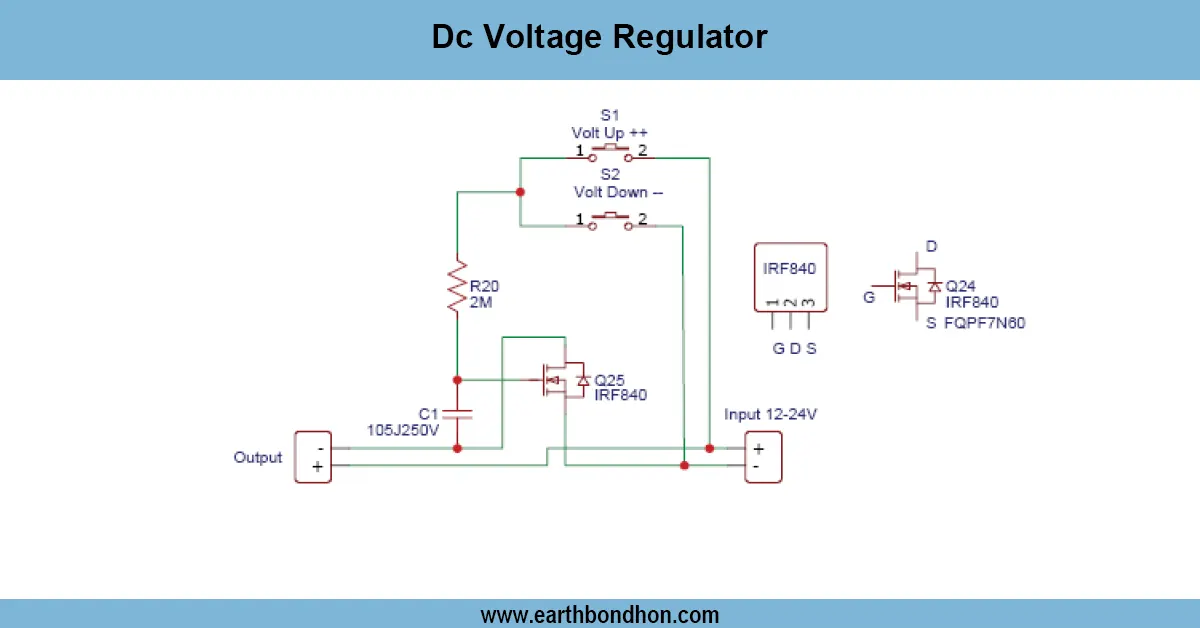
Regulate DC voltage efficiently using the IRF840 MOSFET. Smooth and stable output with adjustable voltage control, ideal for power supply and electronics projec...

adjustable DC power supply MOSFET

IRF840 DC voltage regulator. A DC voltage regulator is made by using IRF840, which can provide a stable DC voltage controlled by the gate voltage of the MOSFET. It is suitable for electronic projects, do-it-yourself power supplies, and battery-driven equipment.

electronic projects for beginners​

The on-off circuit of an IRFZ44N MOSFET is a simple and efficient method of controlling high-current loads like lamps, motors, or LED strips with a control signal of low voltage. IRFZ44N MOSFET is the most appropriate device to use in such circuits since it can conduct high current, has low on-resistance (Rds(on)) is available, and can be switched with logic-level voltages provided by microcontrollers or by manual switches. This self-made project can be used by beginners and hobbyists, and you can easily and safely convert DC or AC loads using only a small number of components. You will be taught in this guide how to put together the circuit, wire the MOSFET, include a gate resistor and pull-down resistor, and test the on-off switching capabilities. Electronic projects can be safely, effectively, and reliably operated by proper installation.

Why Use IRFZ44N for Switching

High Current Handling

  • Can handle up to 49A at low voltage, making it suitable for LEDs, motors, and lamps.

Low Rds(on) for Efficient Switching

  • Reduces power loss and heat generation.

Easy to Control with Logic Level

  • Can be triggered using microcontroller or switch without additional driver circuits.

Components Required

IRFZ44N MOSFET

  • Acts as the main switch to control current flow.

Resistors (Gate Pull-Down / Series)

  • Series resistor limits gate current; pull-down ensures MOSFET stays off when input is low.

Switch or Microcontroller for Input

  • Provides control voltage to turn MOSFET on or off.

Load (LED, Lamp, Motor)

  • Device to be controlled by MOSFET switching.

Power Supply (DC or AC with Isolation)

  • Provides voltage for the load and gate control.

Optional Heat Sink

  • Ensures MOSFET does not overheat under high load.

Working Principle

Gate-Source Voltage Control

  • When Vgs > threshold (~2–4V), MOSFET turns on.
  • When Vgs < threshold, MOSFET stays off.

Switching On and Off

  • Control signal at gate determines whether load is powered or not.

Load Current Flow

  • Drain current flows through load to source when MOSFET is on.
  • Current stops when MOSFET is off.

Circuit Diagram and Assembly Steps

Connecting IRFZ44N MOSFET to Load

  • Drain → load positive, Source → GND, Gate → input signal.
  • AC load requires proper opto-isolation or TRIAC control.

Gate Resistor and Pull-Down Resistor Setup

  • Series resistor (100Ω–220Ω) to gate limits current.
  • Pull-down resistor (10kΩ) keeps MOSFET off when no input.

Input Switch Wiring

  • Mechanical switch or microcontroller pin connected to gate.
  • Provides logic high to turn MOSFET on.

Power Supply Connection

  • Connect load supply according to load voltage.
  • Ensure common ground for DC loads.

Testing the Circuit

  • Apply control signal.
  • Load should turn on/off reliably.
  • Verify MOSFET temperature; add heat sink if needed.

Safety Precautions

  • For AC loads, use opto-isolation or proper insulation.
  • Always disconnect power before wiring.
  • Use MOSFET within its current and voltage ratings.
  • Use heat sink for high-current applications.
  • Avoid short circuits between drain and source.

Applications

  • LED strip on-off control.
  • DC motor switching.
  • Lamp on/off projects.
  • Microcontroller-controlled load switching.
  • DIY electronics and robotics projects.

Troubleshooting and Maintenance

  • MOSFET not switching: Check gate voltage.
  • MOSFET heating: Add heat sink or reduce current.
  • Load always on/off: Verify pull-down resistor and connections.
  • Flickering: Ensure stable control signal.
  • Shorted MOSFET: Replace and check wiring.

Frequently Asked Questions - DC Voltage Regulator:

What is IRF840?

It is an N-channel power MOSFET used for voltage regulation.

Can it regulate high voltage DC?

Yes, IRF840 handles high voltage and moderate current.

Is it adjustable?

Yes, output voltage can be adjusted using gate control.

Do I need a heat sink?

Yes, recommended for continuous operation under load.

Can it handle motors?

Yes, suitable for motor drivers within current rating.

Is it beginner-friendly?

Intermediate level; requires knowledge of MOSFETs and voltage regulation.

Do I need protective components?

Yes, use flyback diodes and fuses for safety.

Can it be used in DIY power supplies?

Yes, ideal for small lab or hobby power supplies.

Does it provide smooth voltage?

Yes, proper gate control ensures stable output voltage.

Is it cost-effective?

Yes, uses readily available IRF840 MOSFET and simple components.

Comments

Please login to comment.

Rojony Khatun

Rojony Khatun

Calculator Tools Project

Rojony Khatun is the creator of a free online tools website designed to simplify everyday and engineering-related calculations for students, professionals, and hobbyists. The platform offers a wide variety of basic and advanced calculators across key categories, including Electrical Calculators, Electronic Calculators, and Time & Date Calculators, helping users solve problems quickly and accurately.