Intelligent 6v 12v 24v battery charging circuit auto cut-off
Build an intelligent 6V, 12V, 24V battery charger with automatic cut-off without a relay. Step-by-step DIY guide with components, working principle, and FAQs.

What Is an Intelligent Battery Charging Circuit?
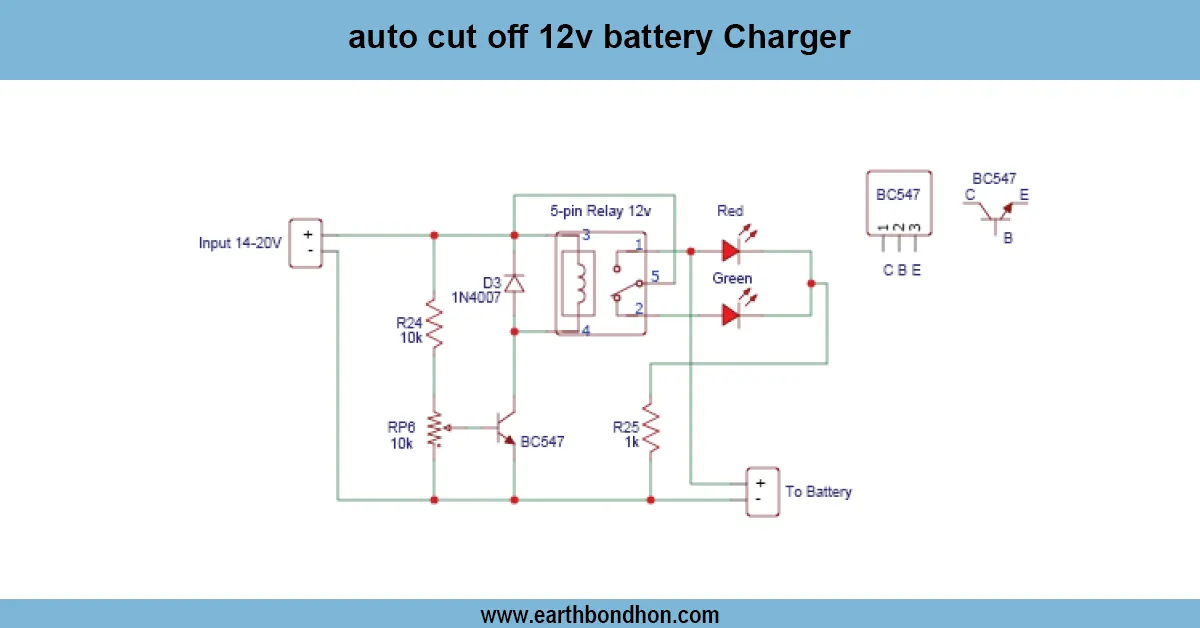
An intelligent battery charging circuit is an electronic circuit that is used to charge a battery and check the voltage of a battery to avoid being overcharged. MOSFET switching is used to perform auto cut-off by a comparator IC, and not electromechanical relays.
6v 12v 24v charger circuit intelligent design
A smart 6-volt-12-volt-24-volt battery charging circuit with an automatic cut-off is fitted to charge batteries efficiently without any overcharging. This DIY circuit requires no relay as opposed to the more traditional chargers; rather, it uses MOSFETs and ICs of the voltage comparator variety to automatically switch off the charging when the battery has reached its full voltage.
The smart 6V 12V 24 volt battery charging circuit with automatic cut-off may be applied with lead-acid, SLA, or lithium-based batteries. It continuously measures battery voltage to make sure that the battery is charged correctly and has a long life. The system is convenient because the state of charging can be indicated through LED indicators. The smart charger is perfect when a user is a hobbyist, uses solar energy, has a small battery bank, and desires an energy-efficient and low-maintenance charger.
Advantages of Auto Cut-Off Battery Charger
- Prevents Overcharging: Automatically stops charging at full voltage.
- Extends Battery Life: Eliminates overheating and acid damage.
- Versatile Voltage Support: Works with 6V, 12V, and 24V batteries.
- Low Component Count: Simple design without relays.
- Energy Efficient: Stops power waste after full charge.
- Visual Indicators: LEDs show charging and full battery status.
Components Required for DIY Circuit
| Component | Quantity | Purpose |
|---|---|---|
| Voltage Comparator IC (LM393 / LM358) | 1 | Detects battery full voltage |
| MOSFET (IRF540N / IRFZ44N) | 1 | Controls charging current |
| Zener Diodes (6.8V / 12V / 24V) | 1 each | Voltage reference |
| Resistors (1k–100kΩ) | Multiple | Divider and biasing |
| Capacitors (0.1µF–10µF) | 2–3 | Filtering |
| LED Indicators | 2 | Charging and full indication |
| DC Power Supply | 1 | Charging power |
| Heat Sink (optional) | 1 | MOSFET cooling |
| Fuse & PCB | 1 | Protection & assembly |
Working Principle of the Circuit
DC Input & Regulation: Power supply provides voltage slightly above the battery.
Voltage Sensing: Comparator monitors the battery via a resistor divider.
MOSFET Switching: MOSFET acts as the charging switch controlled by comparator output.
LED Indicators: Red = charging; Green = full battery.
Safety: Fuse, capacitors, and heat sinks protect the circuit.
Circuit Diagram Explanation
DC Supply → MOSFET Drain → Battery (+)
Battery (-) → Ground

Comparator → Monitors battery via divider
Comparator Output → MOSFET Gate

Red LED → Charging status
Green LED → Full battery indication

Fuse + Capacitors → Safety & filtering
Step-by-Step Construction Guide
- Voltage Reference: Connect Zener diode to comparator reference input.
- Voltage Divider: Create divider from battery to comparator input.
- MOSFET Setup: Drain → supply; source → battery; gate → comparator output.
- LED Indicators: Red = charging; Green = full charge.
- Power Connection: Attach DC supply with fuse.
- Testing: Observe LED switching and MOSFET cut-off at full voltage.
Applications of Intelligent Battery Chargers
- Lead-acid battery charging (UPS, solar)
- SLA or Lithium maintenance
- DIY battery packs (6V/12V/24V)
- Solar home systems
- Off-grid charging setups
Troubleshooting Tips
| Problem | Cause | Solution |
|---|---|---|
| LED always Red | Wrong reference voltage | Check Zener & comparator wiring |
| Battery not charging | MOSFET or supply issue | Check MOSFET orientation & voltage |
| MOSFET overheating | High current | Use bigger heat sink or lower current |
| LED doesn’t turn Green | Wrong threshold | Adjust comparator cutoff point |