Creators
Earth Bondhon Author
Earth Bondhon
CalculatorToolsProjectExpert
Reviewers
Małgorzata Koperska, MD Steven Wooding
Last updated: January 14, 2026

Series Resistor Calculator: Calculate Total Resistance Easily

🇺🇸
English
Default
🇪🇸
Español
Spanish
🇫🇷
Français
French
🇩🇪
Deutsch
German

Series Resistor Calculator

Add Resistor

series resistor calculator

Calculate the total resistance of resistors connected in series quickly and accurately using our Series Resistor Calculator. Ideal for electronics and circuit design.
Resistors in Series Calculator

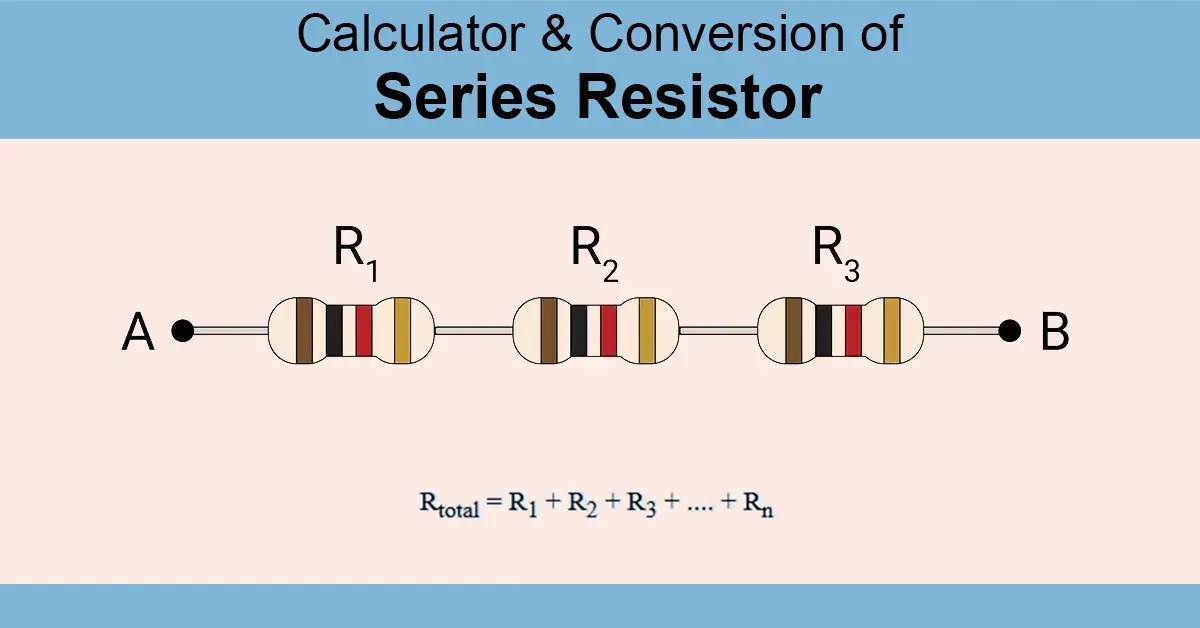
In a series circuit, resistors are connected one after another, and the total resistance is the sum of all individual resistances. The Series Resistor Calculator allows you to input multiple resistor values and instantly calculates the total resistance by adding them together. This is crucial in electronics to predict how much resistance a circuit will have, affecting the current flow and voltage drop. The simple addition formula applies regardless of the number of resistors, making it easy to analyze or design series resistor networks.

voltage current resistance Tools formula

The Ohm Law Calculator is also an indispensable web application for a person dealing with electrical or electronic circuits. According to the basic formula of voltage ( V ), current ( I ), resistance ( R ), and power ( P ), this calculator will find missing values in your circuit rather quickly. This tool is easy to use, and it helps to reduce mistakes in calculations and minimize the errors that could be caused by handwriting in any case (an engineer, an electrician, and a student). With any two known values, e.g., voltage and current, you can immediately calculate the resistance and power based on the Ohm formula: V = I = R and P = V = I. The calculator is suitable for different uses, such as troubleshooting, circuit design, or college learning, in that it supports both DC and AC circuits.

Work & Installation — Input to Output Summary

Input: Enter any two known values (Voltage, Current, Resistance, or Power).

Process: The calculator applies Ohm’s Law equations (V = I × R, P = V × I) automatically.

Output: Instantly display missing parameters like current, voltage, resistance, and power with units.

Testing and Final Adjustments

After the implementation of the Ohm's Law Calculator, check and confirm the results by comparing the results obtained with the theoretical values of the basic circuit equations. Assay using standard resistors and voltage sources, and make sure that the same results are produced on various units (volts, ohms, amperes, watts, etc.). Test for edge cases such as zero or negative values, and test for dynamic user input. When placed on a site, test on a variety of devices, and ensure that the numerical accuracy is not beyond the performance of 0.01. To be utilized at an advanced level, the optional unit conversion and data rounding functionality is required. The last modifications may include input validation, improving the UI, and introducing summaries of the results. Once thoroughly tested, make the calculator available to users and, in the process, monitor the feedback to improve upon functionality and reliability.

Frequently Asked Questions - series resistor calculator:

What is a series resistor?

Resistors connected end-to-end so current passes through each resistor sequentially.

How do I calculate total resistance in series?

Add all individual resistances: Rtotal = R1 + R2 + ... + Rn.

Does the order of resistors affect total resistance?

No, total resistance is the sum regardless of order.

Can I use this calculator for any number of resistors?

Yes, it supports any number of resistor values in series.

What happens to current in a series circuit?

The current is the same through all resistors in series.

Is voltage the same across all resistors?

No, voltage divides across resistors based on their resistance.

Can this calculator help with circuit design?

Yes, it helps design circuits with specific resistance requirements.

What units should resistor values be in?

Resistor values should be entered in ohms (Ω).

How is power dissipated in series resistors?

Power is dissipated in each resistor based on voltage drop and current.

Is this formula valid for AC circuits?

For pure resistors, yes. For reactive components, impedance must be considered.

Comments

Please login to comment.

Earth Bondhon

Earth Bondhon

Calculator Tools Project

Md. Jony Islam is a highly skilled professional with expertise in electronics, electrical, mechanical, and civil engineering, as well as finance. Specializing intransformer service and maintenance for 33/11kV substations, he ensures reliable and efficient electrical systems. His mechanical engineering skills drive innovative designs, while his financial acumen supports effective project budgeting. With a strong foundation in civil engineering, he contributes to robust infrastructure development. Md. Jony Islam's multidisciplinary approach ensures efficiency, quality, and reliability across all projects.