VA to Amps Calculator
Use our free VA to Amps calculator to convert volt-amps to current (A) for single and three-phase systems with formula and table.
Quick Intro: Convert VA to Amps
The VA to Amps Calculator allows you to quickly determine the current (in amperes) from a given apparent power (VA) and voltage. This is essential for understanding electrical loads in both residential and industrial applications. Whether you're working with single-phase or three-phase systems, this tool simplifies the conversion process and helps prevent overloading circuits.
pump shaft power tool Formula:
The Pump Shaft Power Calculator assists engineers in calculating the amount of power needed to propel the centrifugal
and positive displacement pumps. Its power is dependent on the flow rate (Q), total head (H), fluid density ( ρ ),
gravitational constant (g), and the pump efficiency ( η ).
The basic formula used:
\[ P = \frac{\rho \times g \times Q \times H}{\eta} \]
where P is the shaft power in watts (W). The calculator outputs results in kW or HP, making it easier to size motors and evaluate pump performance.
This tool is essential for fluid system design, maintenance planning, and energy optimization. It supports calculations for water, oil, and other fluids across industrial, agricultural, and HVAC applications.
Work & Installation — Input to Output Summary
Inputs:
- Flow rate (Q) – m³/s or L/s
- Total head (H) – meters
- Fluid density (ρ) – kg/m³
- Pump efficiency (η) – %
Process:
- Convert flow rate and head to standard SI units.
- Compute power: \( P = \frac{\rho \times g \times Q \times H}{\eta} \)
- Convert watts to kW or HP as desired.
Outputs:
- Shaft Power (kW and HP)
- Efficiency-corrected motor rating
Applications: Used in pump design, system optimization, and selecting motor ratings for water treatment, irrigation, and industrial flow systems.
Testing and Final Adjustments
Once the shaft power is calculated, put the pump to test in normal working conditions to confirm efficiency and load. Measure the performance of actual input current, voltage, and pressure head. When the measured shaft power is significantly different than the calculated shaft power, examine the possibilities of a flow restriction, impeller wear, or a motor alignment problem. To get optimal flow and energy balance, adjust the speed of the motor or the impeller diameter. Frequent calibration, monitoring enhance reliability, conserve energy, and increase the life span of the pump. Safe operation and correct compatibility of pump and motor ratings are achieved by proper testing.
Frequently Asked Questions - VA to Amps Calculator:
How do I convert VA to amps?
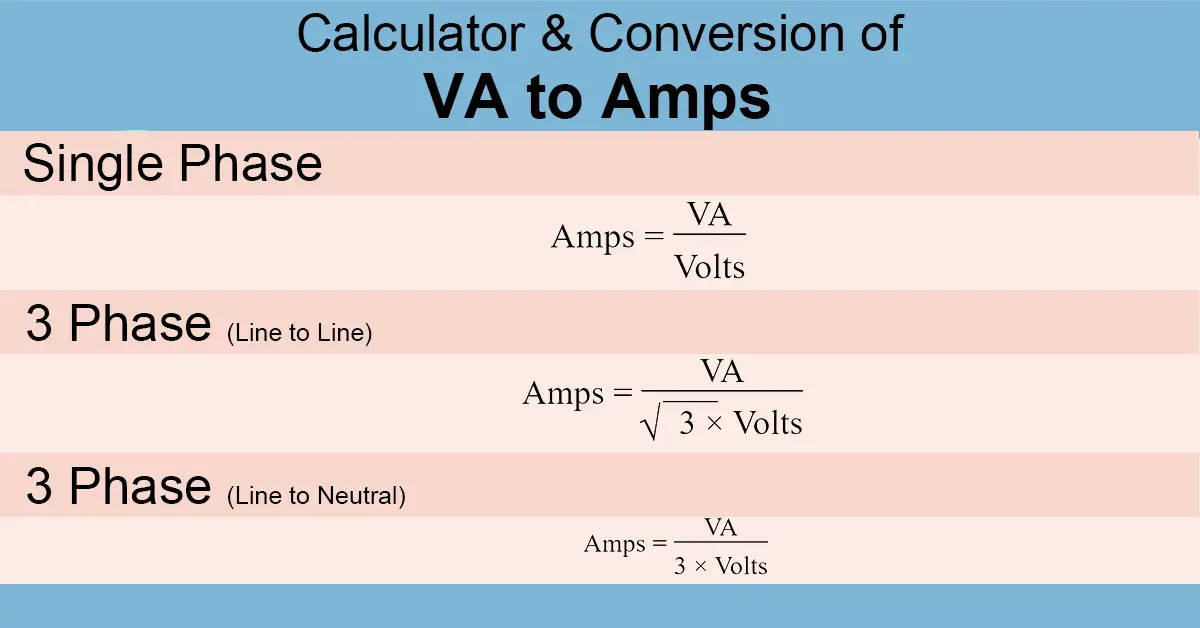
Divide the VA value by voltage: Amps = VA ÷ V.
Is voltage needed to convert VA to amps?
Yes, voltage is required to calculate current.
What is VA?
VA stands for volt-amperes, representing apparent power.
What is the difference between VA and watts?
Watts represent real power; VA is apparent power.
Does power factor affect VA to amps conversion?
No, VA to amps doesn't consider power factor.
How to convert VA to amps for 3-phase systems?
Use I = VA ÷ (√3 × V) for line-to-line voltage.
Can I use this for DC systems?
Yes, simply use I = VA ÷ V for DC too.
What happens if voltage is too low?
Current increases, which can overheat wires.
Is this calculator accurate?
Yes, it's based on standard electrical formulas.
Can this be used for generators?
Yes, for sizing generators based on VA rating.