

12v Battery Level Indicator
Build a simple battery level indicator circuit to monitor battery charge. Displays voltage levels using LEDs for 12V batteries in a cost-effective way.
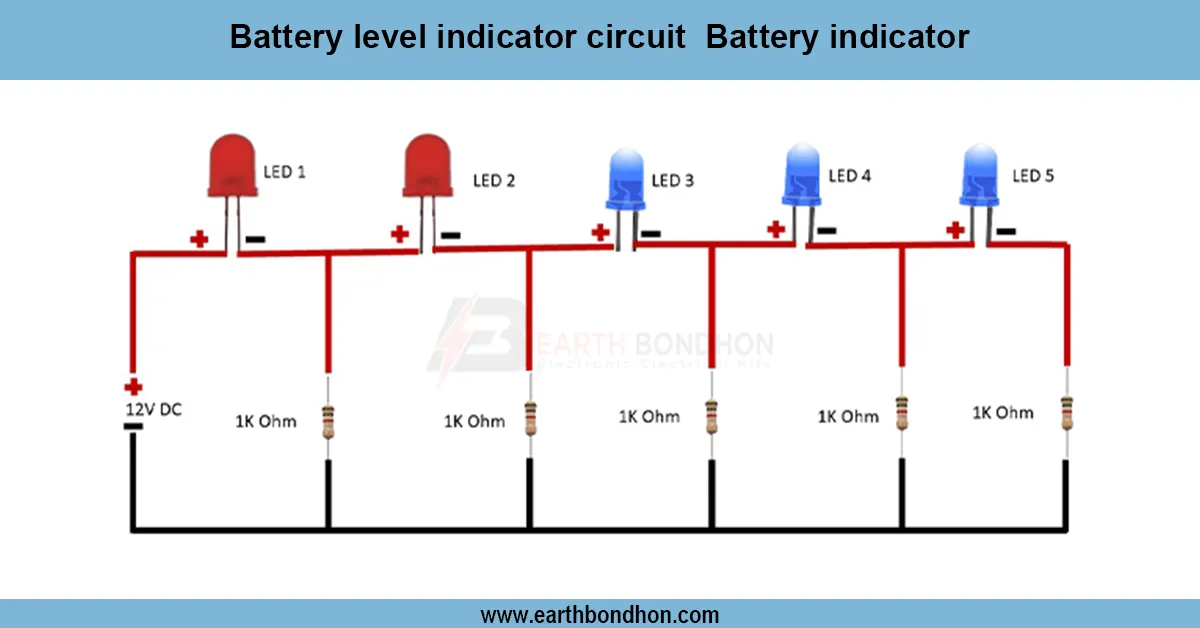
Battery level indicator circuit
A battery level display is a display of battery voltage levels, usually by means of LEDs. It stops over-discharge, keeps the battery in good condition, as it displays full, medium, or low charge levels.
Battery voltage display circuit
A Battery Level Indicator Circuit can be used to check the status of the voltage on a 12V battery, lead-acid battery in vehicles, solar, or UPS backup. Simple transistors or more complicated voltage dividers and comparators (such as LM339) are typically used in the circuit to turn on LEDs with a variety of voltage levels. The LEDs will be used to currently show the level of battery, with each LED corresponding to being fully charged, half-charged, or lowly charged. This indicator will allow preventing over-discharge, will increase battery life, and will enable users to plan recharging. It is also easy to assemble, affordable, and gives battery status clearly on its face. Specifically, it can be used by DIY enthusiasts and in any type of application that requires backup or solar power, or automotive applications.
Work / Installation (Inputs → Outputs)
- Battery Input (12V) connected to voltage divider.
- Comparator/Transistor Circuit detects voltage thresholds.
- LED Output lights up to indicate full, medium, or low charge.
- Connect LEDs with current-limiting resistors and mount on dashboard or battery holder.
Testing & Final Adjustments
Once the battery indicator is assembled, it must be connected to a 12V battery that is fully charged. Make sure that all the LEDs are lit as per the anticipated voltages. Gradually discharge the battery and note which of the LEDs goes off with a decrease in voltage. Calibrate the LED thresholds with the voltage divider resistors or potentiometer. Make sure that current-limiting resistors have been applied to avoid burnout of the LED. Check the circuit under various conditions of battery and under various loads to ensure reliability. After calibration, put the circuit in an open place and insulate it well. Periodically inspect connections to watch out for corrosion or loose wires, particularly in automotive or solar systems.