Auto Street Light Circuit
Learn how an Auto Street Light Circuit works, components, wiring diagram, LDR operation, relay connection, and building an automatic street lighting system.

What is an Auto Street Light Circuit?
Auto Street Light Circuit is a system that regulates the light in the streets depending on the light conditions on the ground. In the case where the light reaches a limit during nightfall, the lamp is automatically switched ON by a circuit. As the daylight increases, the lamp is turned off. This system also does away with manual switches and is efficient in terms of energy.
Automatic street light circuit using LDR
A circuit Auto Street Light is an electronic one that automatically activates the street lights at night and switches them off in the daytime. It consumes less energy and guarantees security on the streets, parks, and highways without human intervention. Such circuits typically consist of an LDR (Light Dependent Resistor) sensor to sense the surrounding light, a relay to emit AC lamps, and a microcontroller to provide sophisticated control.
This manual describes the operating principle, parts, electrical design, disassembling, and assembling of an auto street light circuit, problem-solving, and applications of the circuit in the real world. The newcomers will be able to create a simple automated street lighting system with the help of this guide, or add to it to create a smart city or energy-saving system.
Components Required for Auto Street Light Circuit
- LDR (Light Dependent Resistor)
- Relay (5V or 12V based on control circuit)
- Transistor (e.g., BC547 or 2N2222)
- Resistors (1kΩ, 10kΩ, etc.)
- Diode (1N4007)
- AC Lamp (Street light)
- DC Power supply (5V/12V for relay)
- PCB or breadboard and connecting wires
Working Principle of Auto Street Light Circuit
Role of LDR Sensor
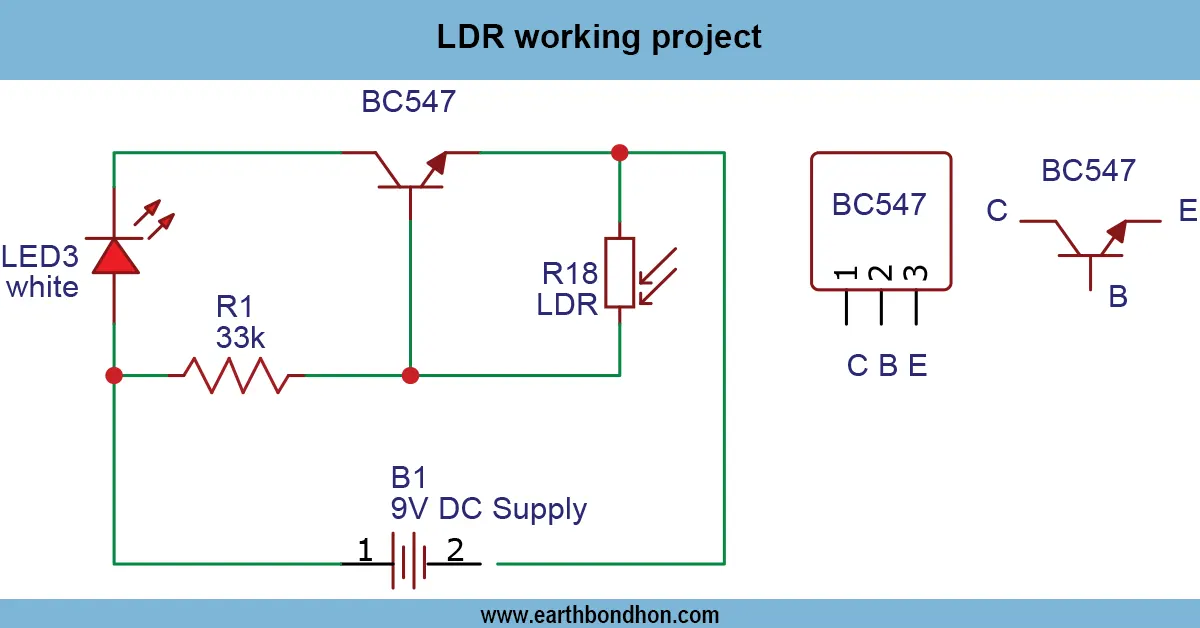
The LDR resistance changes with light intensity: it decreases in daylight and darkness increases . This variation forms a voltage divider with a fixed resistor, which controls the transistor biasing:
$$ V_{base} = V_{CC} \times \frac{R_{LDR}}{R_{fixed} + R_{LDR}} $$
When \(V_{base}\) exceeds the transistor threshold, the transistor conducts and activates the relay.
Relay Operation
The relay acts as an electrically operated switch. When the transistor conducts, current flows through the relay coil, closing the normally open (NO) contact and turning ON the street lamp.
AC Lamp Switching
The relay safely switches the AC mains voltage to the lamp. In darkness, the relay closes the AC circuit, turning the lamp ON. In daylight, it opens, turning the lamp OFF.
Auto Street Light Circuit Wiring Diagram
- Connect the LDR and the resistor as a voltage divider to the base of the transistor.
- Connect the transistor collector to the relay coil.
- Use a diode across the relay coil to prevent back EMF..
- Connect the relay NO (Normally Open) contact to the AC lamp.
- Provide DC supply for transistor-relay circuit (5V/12V).
- Test operation in dark and light conditions.
Step-by-Step Construction Guide
- Mount components on breadboard or PCB.
- Connect LDR in series with a resistor to create a voltage divider.
- Connect the base of the transistor to the voltage divider output.
- Connect the collector to the relay coil and the emitter to the ground.
- Place a diode across the relay coil for protection.
- Connect the AC lamp to the relay contact.
- Provide DC power to the control circuit.
- Test automatic switching at night and day.
Applications of Auto Street Light Circuit
- Street lighting for towns and cities
- Garden and park lighting
- Highway lighting automation
- Home outdoor lighting
- Energy-saving smart lighting projects
Troubleshooting Common Problems
Lamp Not Turning ON
- Check LDR wiring and ensure the transistor is conducting.
- Verify relay coil voltage and DC supply.
Lamp Stays ON During Day
- Check resistor values in LDR voltage divider.
- Ensure LDR is exposed to daylight.
Relay Clicking But No Light
- Check AC wiring to the lamp.
- Ensure NO contact is correctly connected.