How to Make AC Fan Regulator Circuit
Learn how to make an AC fan regulator circuit at home. Step-by-step DIY guide with components, working principle, circuit diagram, and safety precautions.

What is an AC Fan Regulator?
An AC fan regulator is an electronic circuit that controls the speed of an AC fan. The modern fan regulators, unlike the simple voltage dividers, utilize the phase control methods to accurately cut down the voltage without wasting power in the form of heat.
Key features:
- Smooth speed adjustment
- Energy-efficient design
- Suitable for 220V AC fans
- Can be manual or electronic
Home fan speed adjustment circuit
With a DIY AC fan regulator circuit, you are able to regulate the speed of an AC ceiling or table fan, with the ability to save both time and money. With the help of the AC voltage given to the fan, you can save energy, improve comfort, and prolong the lifespan of the fan.
The most widely encountered one employs a triac that has phase-cut. A diac is used to fire the triac at certain instances of the AC cycle, which essentially causes a reduction in the voltage provided to the fan. The project can be appropriate for hobbyists, electronics fans, and any other person who desires a low-cost and reliable fan speed controller.
Here, we are going to describe the principle of working, parts, step-by-step assembly, and circuit diagram of an effective AC fan regulator. The precautions in working with AC mains voltage are also emphasized, as it is not always safe to work with high voltage.
Applications of AC Fan Regulator Circuit
- Controlling ceiling fan speed
- Adjusting table or wall fan speed
- Saving electricity in hot climates
- Smooth operation for motor longevity
- DIY home automation projects
Components Required
| Component | Specification |
|---|---|
| Triac | BT136 / BTA16 (220V AC, 4A) |
| Diac | DB3 or similar for triggering |
| Potentiometer | 500kΩ (linear) |
| Resistors | 180Ω, 330Ω |
| Capacitor | 0.1μF, 400V AC rated |
| Heat sink | For Triac |
| AC Fan | 220V AC, any standard fan |
| Wires & PCB | For connections and assembly |
Working Principle
Phase Control Using Triac
The triac acts as a switch for AC current. By controlling when it triggers during each AC cycle, we can adjust the effective voltage to the fan.
Triggering with Diac
The diac triggers the triac only after the capacitor reaches a specific voltage, ensuring smooth conduction and stable fan speed.
AC Voltage Adjustment
The potentiometer adjusts the charging time of the capacitor.
• Faster charging → early triac firing → higher fan speed
• Slower charging → delayed firing → lower fan speed
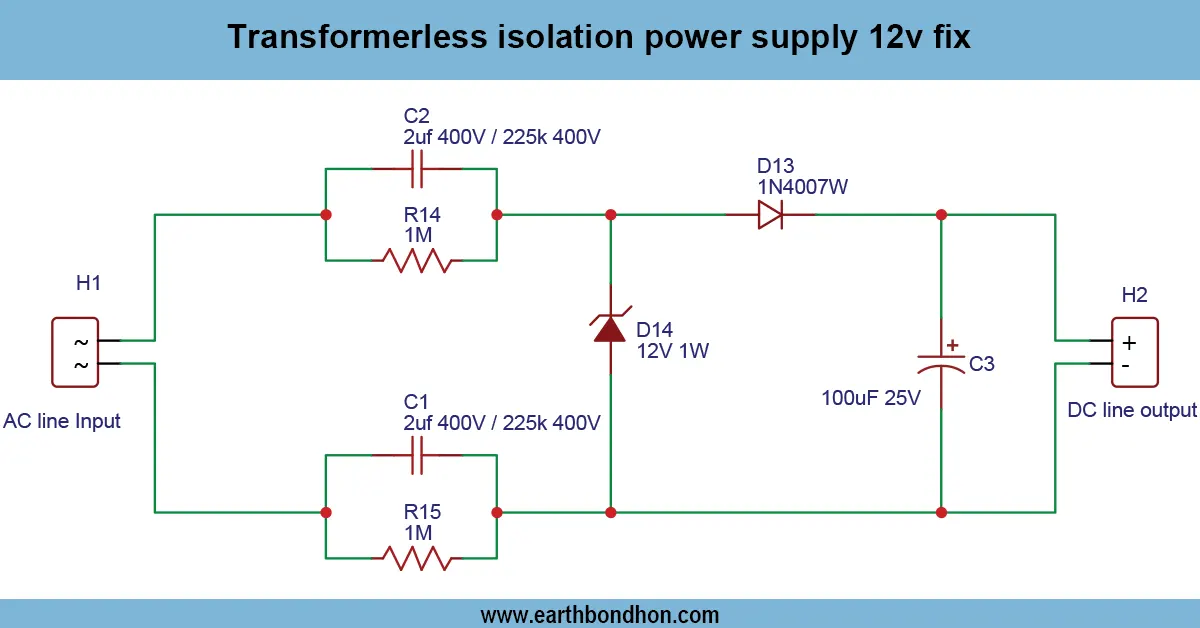
Circuit Diagram of AC Fan Regulator
- Connect AC live input to one terminal of fan and series triac.
- Triac gate connected via resistor-capacitor-potentiometer network.
- Diac triggers triac at desired phase of AC.
- Neutral connected directly to fan.
- Add heat sink on triac to avoid overheating.
Step-by-Step Construction Guide
- Mount triac on PCB with a heat sink.
- Connect diac between potentiometer-capacitor junction and triac gate.
- Connect resistor in series with potentiometer for smooth adjustment.
- Connect fan in series with triac main terminals.
- Apply AC mains carefully and check fan operation.
- Adjust potentiometer to test speed control.
Tips for Better Performance
- Use high-quality components for reliability.
- Keep wiring short and insulated.
- Ensure triac rating exceeds fan current.
- Avoid touching circuit while powered.
- Add small capacitor across fan for noise suppression.
Safety Precautions
- Never touch circuit under AC mains.
- Always use proper insulation.
- Test with fused AC supply initially.
- Ensure triac heat sink is mounted securely.
- Keep children away from high voltage circuits.
Troubleshooting Common Issues
Fan Not Running
- Check AC connections
- Ensure triac and diac are properly connected
Fan Speed Not Changing
- Verpotentiometer wiringring
- Check capacitor and diac function
Triac Overheating
- Ensure heat sink is adequate
- Avoid fan loads above triac rating