Creators
Md Jony Islam Author
Md Jony Islam
CalculatorToolsProjectExpert
Reviewers
Małgorzata Koperska, MD Steven Wooding
Last updated: January 14, 2026

Single Push Button On-Off Switch Circuit Using IRFZ44N & BC557

🇺🇸
English
Default
🇪🇸
Español
Spanish
🇫🇷
Français
French
🇩🇪
Deutsch
German
BC547 Transistor

BC547 Transistor

General-purpose NPN bipolar junction transistor (BJT)

IRFZ44N MOSFET

IRFZ44N MOSFET

N-channel power MOSFET, Vds 55V, Id 49A, Rds(on) ~0.032Ω, used for switching high-current loads efficiently in electronics projects and motor control circuits

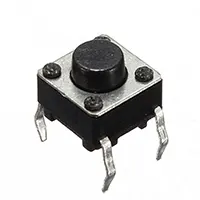
Mini Push Button Switch

Mini Push Button Switch

A simple mechanical switch used to make or break a circuit when pressed. It returns to its original position once released. Commonly used in doorbells, calculators, reset buttons, and control panels.

1µF Capacitor

1µF Capacitor

Fixed value, non-polarized/polarized capacitor

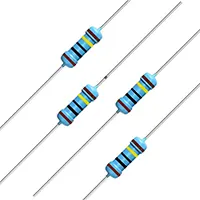
10K Fixed Resistor 1/4W

10K Fixed Resistor 1/4W

A 10,000-ohm resistor rated for 0.25 watts

[10k-fixed-resistor-1/4w]
1m Fixed Resistor 1/4W

1M Fixed Resistor 1/4W

A 1 megaohm fixed resistor rated at 0.25 watts (¼W), used to limit current, drop voltage, or set biasing levels in electronic circuits.

*Please note: These are affiliate links. I may make a commission if you buy the components through these links. I would appreciate your support in this way!

Single Push Button on-off Switch

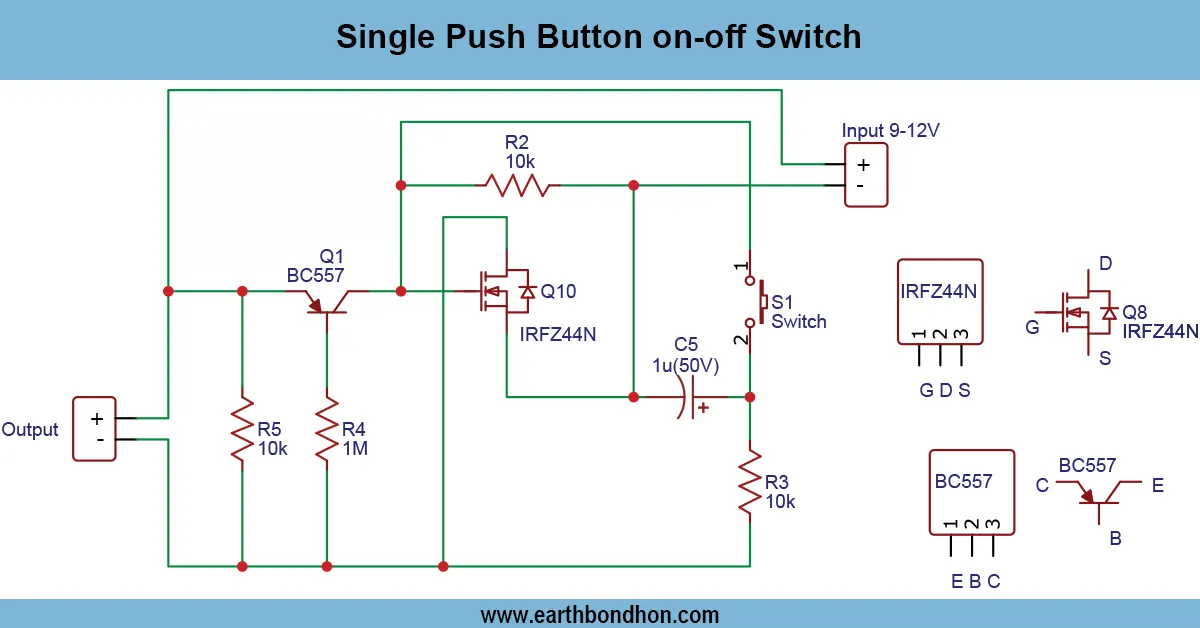
Build a simple single push button on-off switch using IRFZ44N MOSFET and BC557 transistor. Ideal for controlling DC loads in DIY electronics projects.
push button switch IRFZ44N:

The DC loads can be switched with the press of a single push-button on-off switch using IRFZ44N and BC557. The MOSFET is activated by the BC557, and the transfer of high current at constant speed is possible without mechanical relays.

TIP3055 transistor charger:

A simple but effective battery charger with a TIP3055 transistor is a dependable and variable charger to charge batteries 6V and 12V safely. The TIP3055 is a current booster, enabling the charger to provide increased currents without overheating; therefore, it applies to lead-acid, small rechargeable, and maintenance batteries. The circuit normally consists of a voltage regulator, current-limiting resistors, and an ammeter/voltmeter to check the charging process (optionally). The charging voltage and current can be set by the users depending on the battery specifics to provide safe and efficient charging. Appropriate assembly. The TIP3055, resistors, diodes, and regulator should be designed to fit on a PCB or heat-sinked enclosure to avoid overheating. The battery and the components should not be damaged by improper polarity, insulation, or connections. It is low-priced, small, and consumes very low power, which makes this charger ideal for hobbyists, electronics lovers, and small maintenance. It offers regulated voltage and current, prevents battery overcharging, guarantees long life of the battery, and also gives a practical comprehension of the power circuits based on transistors.

⚡ Work & Installation (Input → Output):

The universal battery charger based on TIP3055 operates via the control of current and voltage to be able to charge batteries safely. The base circuit is connected to the input DC voltage, a nd the IP3055 transistor increases the current to the battery as required, but with the desired voltage. Variable resistors enable users to regulate the charging voltage and current for the type of battery. There is an optional ammeter and voltmeter that assist in monitoring the charging process. Installation: To prevent the overheating of transistors, the TIP3055, resistors, diodes, and voltage regulator should be wired together in a PCB or heat-sinked system. Plug in the input DC source and set the voltage to either 6 V or 12 V, depending on the battery, and connect the battery terminals accordingly. Wiring should all be insulated, and polarity should be correct to avoid damage. This design is versatile so that several types of batteries can be charged safely and efficiently, and also ensures that the transistor and battery are not overheated or overloaded.

Testing & Final Adjustments:

Once the TIP3055 battery charger is assembled, a DC input source should be connected and the output voltage measured, with no battery. Depending on the battery voltage (6V or 12V), set the voltage potentiometer. The last step is to connect the battery with the right poles and use an ammeter to measure the current. Make sure that the charge current is not more than the recommended rating of the battery. The TIP3055 transistor can be charged with a heatsink when a high current is used because it gets overheated easily. Monitor the first charge cycle to ensure that the voltage and current are constant. Adjust the resistors as needed to adjust the output. All connections should be insulated and well-ventilated to prevent heat buildup. The charger can charge and support different types of batteries once checked and verified to be safe to use. The DIY TIP3055 universal charger is a dependable, adjustable, and inexpensive system to use by hobbyists, electronics amateurs, and small systems maintenance, with a controlled amount of current and voltage, as well as guaranteeing the battery life and safety.

Frequently Asked Questions - Single Push Button on-off Switch:

What is IRFZ44N?

It is an N-channel MOSFET used for switching DC loads.

What is BC557?

A PNP transistor used to drive the MOSFET gate.

Voltage requirement?

Matches the DC load voltage, typically 5–24V.

Can it handle high current?

Yes, depending on MOSFET rating and heatsinking.

Is it beginner-friendly?

Yes, simple components and easy assembly.

Applications?

LEDs, small motors, hobby electronics devices.

Can it replace mechanical relays?

Yes, provides silent and stable switching.

Do I need a heatsink?

Recommended for higher current loads on MOSFET.

Push button type?

Momentary push button is required for toggling.

Can it be mounted on PCB?

Yes, ideal for PCB or breadboard assembly.

Comments

Please login to comment.

Md Jony Islam

Md Jony Islam

Calculator Tools Project

Founder of Earthbondhon.com

a free online tools website designed to make everyday and engineering-related calculations easier for students, professionals, and hobbyists. The site offers a wide range of basic calculators across key categories, including Electrical Calculators, Electronic Calculators, and Time & Date Calculators.