Volts to Watts Calculator
Instantly convert volts to watts using this free online calculator. Supports DC, single-phase, and three-phase AC with formula, examples, and table.
Advertisement
Quick Intro: Convert Volts to Watts
To convert volts to watts, you need to know the current (amperes) and power factor (for AC). The formula varies based on the type of circuit—DC, single-phase AC, or three-phase AC. This calculator simplifies those calculations for you.
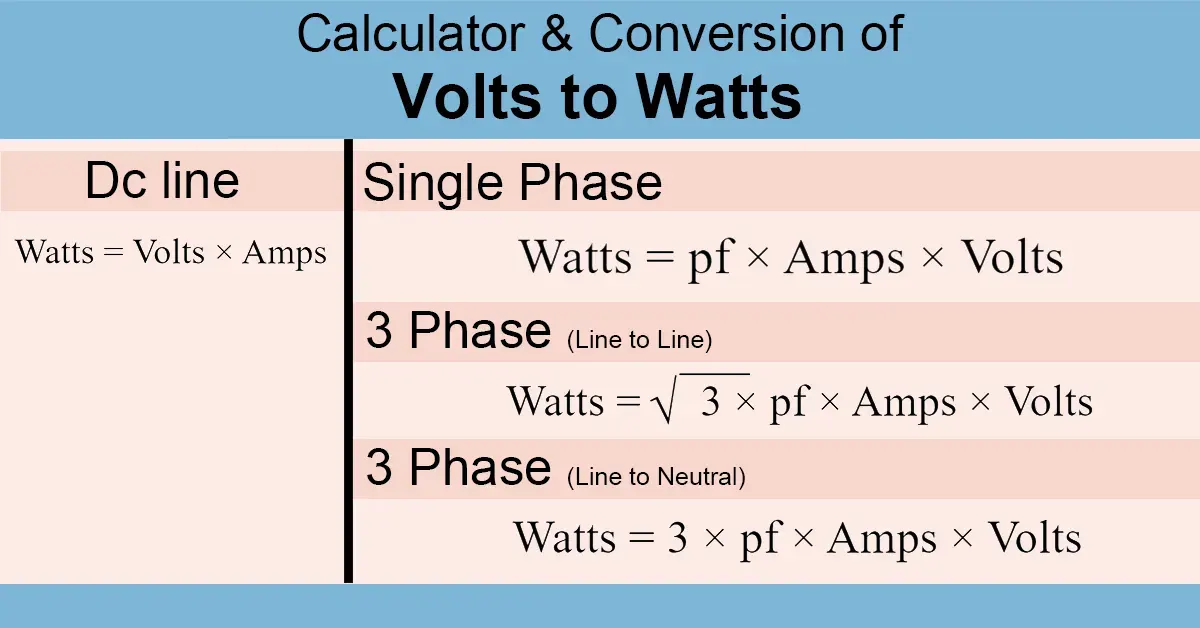
Formula to Convert Volts to Watts
- DC:
Watts = Volts × Amps - Single Phase AC:
Watts = Volts × Amps × PF - Three Phase AC:
Watts = √3 × Volts × Amps × PF
Sponsored
Volts to Watts Calculator Overview
The Volts to Watts Calculator helps you quickly convert voltage to power. Whether you're working with DC, single-phase AC, or three-phase AC systems, this tool uses the correct formula to give you real-time watt values. Perfect for engineers, electricians, and students.
Sample Volts to Watts Canversion Table
| Volts | Amps | PF | Watts (DC) | Watts (1-Phase) | Watts (3-Phase) |
|---|---|---|---|---|---|
| 120 | 10 | 0.9 | 1200 | 1080 | 1870.4 |
| 230 | 5 | 0.8 | 1150 | 920 | 1592.25 |
Advertisement
Frequently Asked Questions - Volts to Watts Calculator:
Multiply volts by amps. For AC, also multiply by the power factor and √3 for 3-phase.
Watts = Volts × Amps.
No, power factor is only used in AC circuits.
It’s a number (0–1) that shows how efficiently electrical power is used in AC circuits.
Use Watts = Volts × Amps × Power Factor.
Use Watts = √3 × Volts × Amps × PF.
Yes, it supports DC, single-phase, and three-phase systems.
√3 ≈ 1.732, used in 3-phase AC power calculations.
Yes, especially for calculating power usage based on voltage and current.
Yes, it's helpful when calculating wattage output based on system voltage and current.