Creators
Rojony Khatun Author
Rojony Khatun
CalculatorToolsProjectExpert
Reviewers
Małgorzata Koperska, MD Steven Wooding
Last updated: January 14, 2026

LDR Light Sensor Circuit Project Using BC547 Transistor

🇺🇸
English
Default
🇪🇸
Español
Spanish
🇫🇷
Français
French
🇩🇪
Deutsch
German
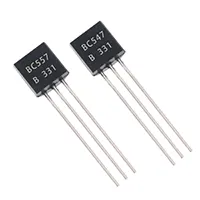
BC547 Transistor

BC547 Transistor

General-purpose NPN bipolar junction transistor (BJT)

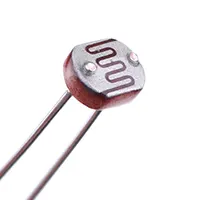
LDR (light-dependent resistor)

LDR (light-dependent resistor)

A resistor whose resistance decreases with increasing incident light intensity; also called a photoresistor

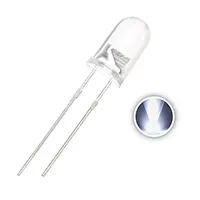
3V LED 5mm

3V LED 5mm

3V, 5mm round light-emitting diode

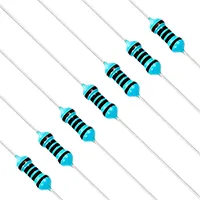
4.7k Fixed Resistor 1/4W

4.7k Fixed Resistor 1/4W

A 4700-ohm resistor rated for 1/4 watts

100R Fixed Resistor 1/4W

100R Fixed Resistor 1/4W

A 100-ohm resistor rated for 0.25 watts

*Please note: These are affiliate links. I may make a commission if you buy the components through these links. I would appreciate your support in this way!

LDR Project

Build an LDR-based light sensor circuit using BC547. Detect ambient light levels to control LEDs or relays automatically for DIY electronics projects.
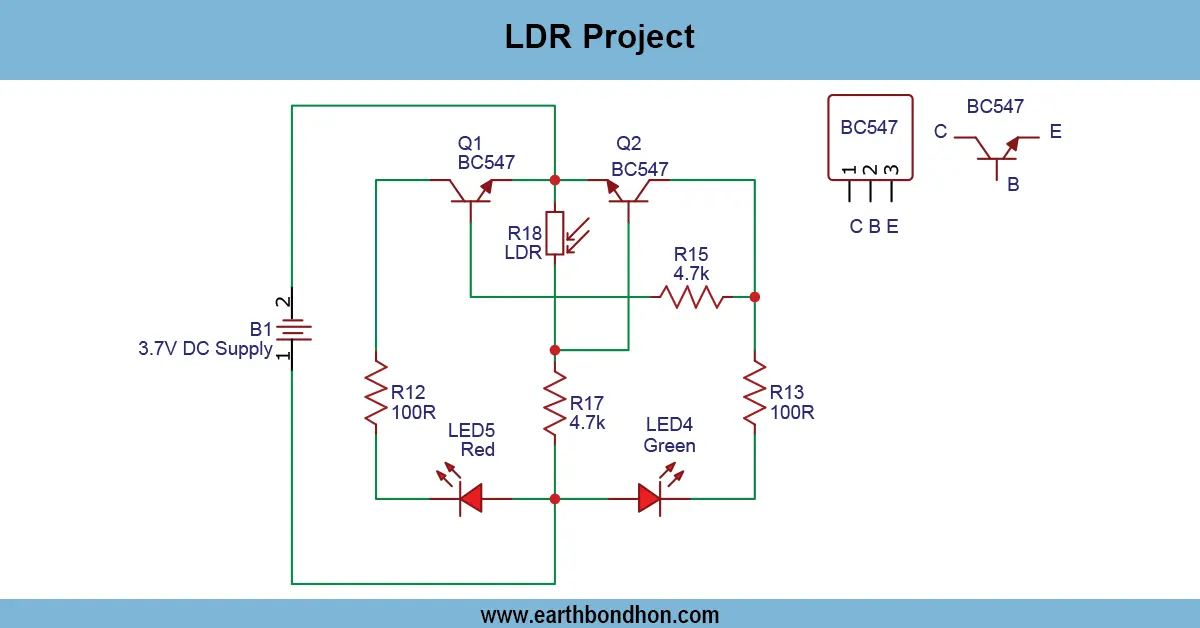
LDR BC547 light sensor circuit

One of the applications of the LDR project is flipping lights, such as LEDs or relay,s based on the amount of light present in the environment with the help of a BC547. It is perfect to study the idea of transistor switching and to creathomemadede light-sensitive circuits.

DIY dimmer light circuit

Simple Dimmer Light Circuit Simple dimmer light circuit for incandescent lamps is an electronic project DIY that represents the solution of modern electronic systems increasingly pursued in the economy. You can dim or brighten the light as you wish by either decreasing or increasing the voltage/duty cycle that is sent to the light. This project is for both AC and DC lights and can serve as a way to teach students or hobbyists simple power control techniques.

Here is how a dimmer light circuit works and what its components are. A circuit diagram and, construction of a schematic of a dimmer light are explained. With TRIACs for AC lights or MOSFETs for DC lights, smooth brightness variation can be achieved. Perfect for home lighting, desk lamps, DIY electronics learning and experiments. Correct installation prevents risk to operating safety, good fitment and fine adjustment; Protects your lighting.

Components Required for the Circuit

  • TRIAC (e.g., BT136) for AC light control
  • DIAC for triggering TRIAC (for AC dimmer)
  • MOSFET (e.g., IRFZ44N) for DC dimmer
  • Potentiometer (10kΩ–100kΩ) for brightness adjustment
  • Resistors and capacitors (for triggering and filtering)
  • AC or DC light source
  • Heat sink (for TRIAC/MOSFET if needed)
  • Breadboard or PCB and connecting wires

Working Principle of Dimmer Light Circuit

Phase Control for AC Lights

AC voltage is chopped using TRIAC and DIAC to adjust the phase angle. The light receives less voltage for lower brightness and more voltage for higher brightness.

PWM Control for DC Lights

A MOSFET switches the DC light rapidly using PWM. Brightness is controlled by changing the duty cycle of the PWM signal.

TRIAC or MOSFET Switching

TRIACs handle high AC loads safely, triggered via DIAC and RC network. MOSFETs handle DC loads efficiently with minimal heat and power loss.

Circuit Diagram of Simple Dimmer Light

  • For AC dimmer: Connect TRIAC in series with AC load.
  • Trigger TRIAC with DIAC through RC network controlled by potentiometer.
  • For DC dimmer: Connect MOSFET in series with DC load.
  • Use PWM generator to adjust MOSFET gate voltage.
  • Apply correct AC or DC power supply.
  • Brightness should change smoothly with the potentiometer.

Step-by-Step DIY Construction Guide

  1. Mount TRIAC/MOSFET, DIAC, resistors, capacitors, and potentiometer on breadboard or PCB.
  2. Connect light load to TRIAC/MOSFET output.
  3. Wire potentiometer to control triggering or PWM input.
  4. Apply AC or DC power depending on circuit type.
  5. Test brightness adjustment with the potentiometer.
  6. Use heat sinks for high-current applications.
  7. For AC circuits, enclose in a safe insulated casing.

Applications of Dimmer Light Circuit

  • Home lighting adjustment (AC lamps)
  • Desk lamps and LED strip brightness control (DC)
  • Mood and decorative lighting
  • DIY electronics projects
  • Small DC fan speed control using PWM

Safety Precautions

  • For AC dimmers, ensure proper insulation and avoid touching live wires.
  • Use heat sinks where required for TRIAC/MOSFETs.
  • Use potentiometers and components with proper voltage/current ratings.
  • Test with low-power loads before controlling high-power devices.

Troubleshooting Common Issues

Light Flickering

  • Check TRIAC and DIAC wiring.
  • Ensure filtering capacitor values are correct.

Limited Dimmer Range

  • Adjust RC network or PWM duty cycle range.

TRIAC Not Switching Properly

  • Verify gate resistor and DIAC wiring.
  • Ensure the TRIAC matches the load current rating.

Frequently Asked Questions - LDR Project:

What is LDR?

Light Dependent Resistor whose resistance varies with light intensity.

Why use BC547?

It acts as a switch to control LEDs or other devices based on LDR voltage.

Can it control relays?

Yes, with proper relay rating compatible with BC547 current.

What voltage is required?

Typically 5–12V DC supply.

Is it beginner-friendly?

Yes, simple components and easy to assemble on breadboard or PCB.

Can I adjust sensitivity?

Yes, by changing the series resistor value with LDR.

Can it be used for night lamps?

Yes, ideal for automatic night lamps and garden lights.

Do I need additional protection?

Optional fuse or diode for load protection.

What type of LED can be used?

Standard low-current LEDs or small 12V LEDs with resistor.

Is it cost-effective?

Yes, uses inexpensive components like BC547, resistors, and LDR.

Comments

Please login to comment.

Rojony Khatun

Rojony Khatun

Calculator Tools Project

Rojony Khatun is the creator of a free online tools website designed to simplify everyday and engineering-related calculations for students, professionals, and hobbyists. The platform offers a wide variety of basic and advanced calculators across key categories, including Electrical Calculators, Electronic Calculators, and Time & Date Calculators, helping users solve problems quickly and accurately.