



Remote Control Switch Board Connection
Learn remote control switch board wiring for lights or appliances, including connections, relay integration, and safe operation for home automation systems.
wireless appliance control wiring
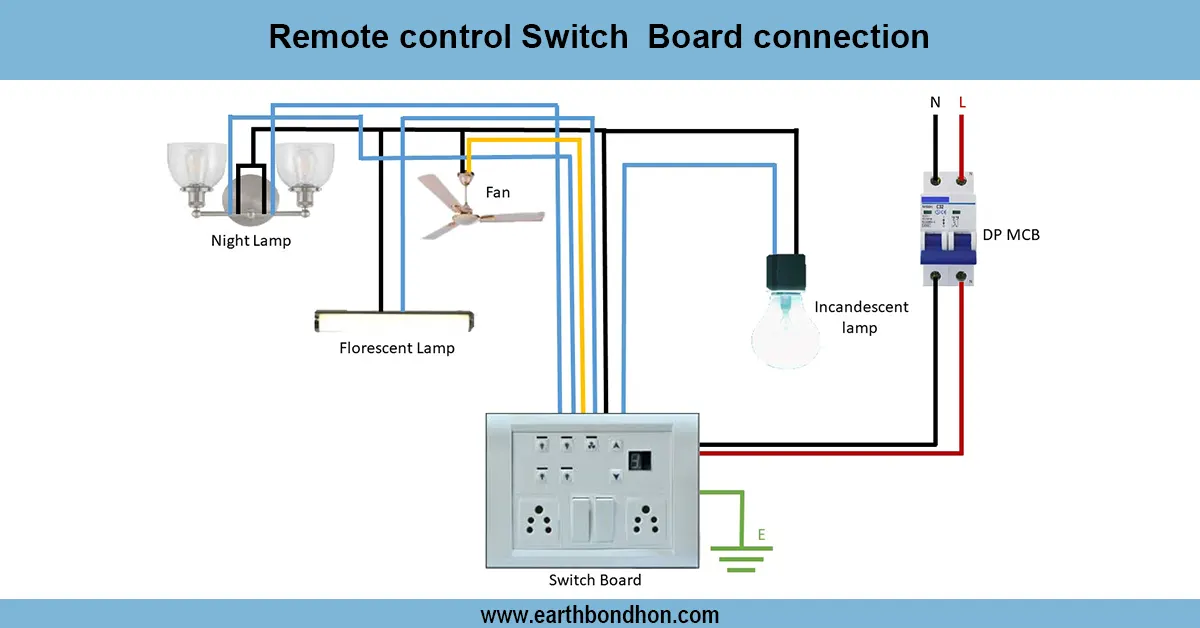
A wireless operation of lights or appliances is made possible by a remote control switch board. It also combines relays to provide safe control of loads and includes manual override provisions.
smart switch board connection
A remote control switch board enables wireless access to lights, fans, or other appliances by RF, Wi-Fi, or IR signals. The remote signal is passed to the switchboard board which energizes internal relays to switch the load. Examples of proper wiring would be live, neutral, earth connections, and connections of the output terminals with the corresponding devices. There are also boards where manual switches are permitted as overrides. A switchboard selected should be rated for the load current and voltage. MBC or fuse is a protection device that helps to avoid a short circuit or overload. Home automation, industrial lighting, or appliance control is done using remote control boards, which are convenient and save energy. Testing is done by connecting the remote to the board, checking the activation of the relays, and ensuring that the devices that are connected to it are functioning as expected. Secure working conditions, less wear and tear on switches, and the ability to change the control of various devices are guaranteed by proper installation.
Work & Installation (Input → Output Summary)
- Connectlive, neutral, and earth to the switch board power terminals.
- Connectoutput terminals to the devices to be controlled (lights, fans, etc.).
- Pair the board with theremote control according to manufacturer instructions.
- Optionally, connectmanual override switches for direct operation.
- Installfuses or MCBs to protect the circuit.
- Mount the board in a safe and accessible location.
- Test all remote buttons to ensure proper relay activation.
- Check load devices for correct ON/OFF operation.
Testing & Final Adjustments
- Verify live, neutral, and earth connections are secure.
- Test remote pairing with the switch board.
- Press each remote button and observe device operation.
- Test manual override switches if present.
- Ensure relay clicks correspond with remote commands.
- Check for short circuits or loose connections.
- Confirm MCB or fuse protection is functional.
- Test multiple devices controlled by the board simultaneously.
- Adjust board placement for proper signal reception.
- Document wiring and remote functions for maintenance.