Submersible Pump Wiring
Learn how to run a submersible motor without a starter, including direct wiring, protection measures, and safe operation for small water pumping applications.
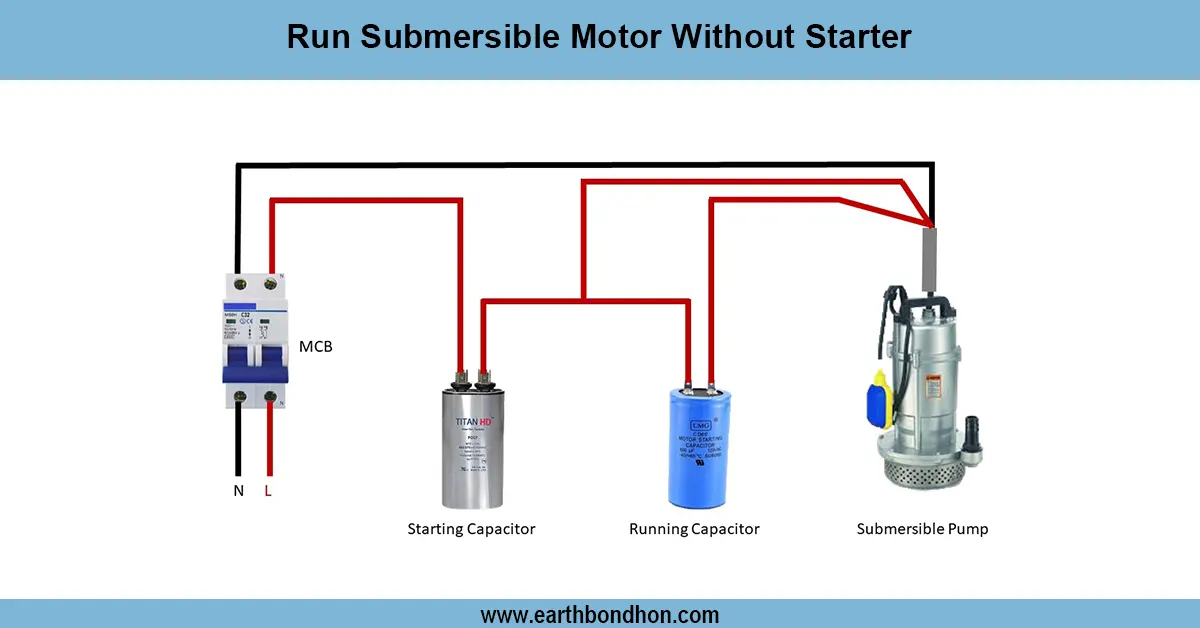
submersible motor control diagram
Direct online wiring could be used to operate a submersible motor without a starter. Adequately protected live, neutral, and earth connections can be safely operated in the short run.
submersible pump electrical guide
Direct online (DOL) wiring can be used to operate a small load requiring no starter or a temporary installation setup. The primary live and neutral feed is then hard-wired to the terminals of the motor, and the earth is grounded. Although this skipped the starter saves cost and complexity, the overload protection and soft start are missing, thus only applicable in small motors or short-term testing. An MCB, fuse, or thermal protector must be placed in the supply line to guard against the motor. The correct rotation requires a proper sequence of the phases, and the cables should be of sufficient grade to handle the full load current of the motor. Testing entails the use of power, checking motor rotation, current, and temperature. Operating a submersible motor without a starter must be done in order to ensure a short run-time, supervision, and safety precautions to avoid the destruction of the motors and electrical risks.
Work & Installation (Input → Output Summary)
- Identify motor live, neutral, and earth terminals.
- Connect live and neutral supply directly to motor terminals.
- Connectearth wire to motor body for safety.
- Install MCB or fuse in series to protect against overcurrent.
- Checkcable rating matches motor full load current.
- Maintain correctphase sequence for three-phase motors.
- Mount the motor securely in water or a borehole.
- Apply power briefly and monitor operation.
Testing & Final Adjustments
- Verify live, neutral, and earth connections are correct and secure.
- Checkmotor rotation direction (swap phases if incorrect).
- Ensurecable insulation and proper ratings.
- Observecurrent draw; it should not exceed rated current.
- Monitormotor temperature during operation.
- Confirm MCB or fuse trips correctly under overload conditions.
- Inspect forvibrations or abnormal noise.
- Test under no-load and partial load conditions first.
- Document wiring and safety precautions.
- Avoid continuous operation without a starter or overload protection.