12V 220V 555 Timer IC 3000W Pure sine wave Inverter
Build a 12V to 220V 3000W pure sine wave inverter using a 555 Timer IC. Complete guide with circuit diagram, components, working principle, assembly, and troubleshooting for high-power applications.

Introduction to 12V to 220V Pure Sine Wave Inverter
An inverter made using a pure sine wave gives a smooth AC signal with no harmonic content, and resembles the Mains
electricity waveform. It can be used with sensitive electronics, AC motors, and power tools, unlike modified sine wave
inverters. The 555 Timer IC drives the MOSFETs by forming a precise frequency of oscillation, usually 50Hz or,60Hz to
activate the battery voltage across the transformer to create ate 220 V AC output.
This inverter can be used in home backup systems, solar power systems, and also in industry, with high loads up to 3000,
with adequate heat management and component selection.
chinese solar power inverters
One of the power projects is an electronic project, which is a powerful 12V 220V 3000W pure sine wave inverter based on a 555 Timer IC, which converts a DC voltage of 12V from the battery into a clean 220V AC energy that can power household and industrial electronics. The inverter relied on a 555 timer IC as an oscillator, MOSFETs as fast switches, and a step-up transformer to produce a constant pure sine output that is capable of serving a load of up to 3000W. Pure sine wave inverters are also desirable in comparison with modified sine wave types since they are safe when it comes to delicate electronics like laptops, medical devices, and AC motors. This manual includes the parts, schematic, operating principle, assembly procedures, and troubleshooting, enabling electronics enthusiasts and professionals to assemble a high-power, robust inverter out of simple parts.
Features of the Inverter
Pure Sine Wave Output
- Smooth AC waveform suitable for all appliances.
- Safe for sensitive electronics like computers and medical devices.
High Power 3000W Output
- Capable of running high-load appliances.
- Requires proper battery capacity (deep cycle 12V batteries).
Stable Voltage and Frequency
- 555 timer ensures stable frequency (50Hz).
- MOSFET drivers provide efficient voltage switching.
Components Required
555 Timer IC
- Configured as astable multivibrator to generate a square wave.
MOSFETs / IGBTs
- High current switching devices to drive transformer primary.
- IRF540N or similar MOSFETs recommended.
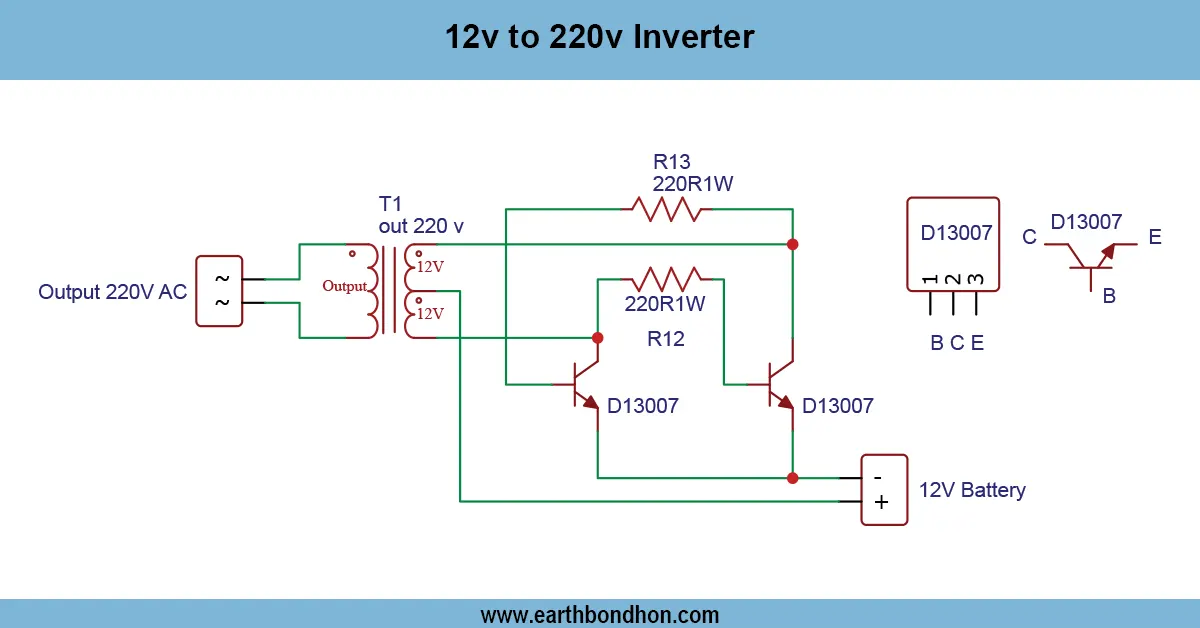
Transformer (12V to 220V)
- Step-up transformer to convert 12V DC to 220V AC.
- Rated for high power (3000W).
Resistors, Capacitors, and Diodes
- Resistors and capacitors set 555 timer frequency.
- Diodes protect against reverse current.
Heatsinks and Cooling Fans
- Essential for high power MOSFET operation.
- Prevent overheating and ensure longevity.
Working Principle
555 Timer Oscillator Circuit
- 555 Timer generates 50Hz square wave.
- Duty cycle adjusted to produce balanced positive and negative cycles.
MOSFET Switching
- Square wave from 555 timer drives MOSFETs.
- MOSFETs switch 12V DC across the transformer primary rapidly.
Transformer Step-Up and Sine Wave Generation
- Transformer steps up 12V DC pulses to 220V AC.
- Optional LC filter smooths waveform to approximate pure sine wave.
- Output can drive sensitive electronics safely.
Circuit Diagram and Assembly Steps
555 Timer Configuration
- Connect resistors and capacitor to set frequency at 50Hz.
- Use complementary outputs to drive MOSFET gates.
MOSFET Driver Stage
- Use gate resistors and protective diodes.
- Ensure heatsinks are properly mounted.
Transformer and Output Stage
- Connect MOSFET drain/source to transformer primary.
- Secondary provides 220V AC output.
- Optional LC filter reduces harmonics.
Testing the Inverter
- Connect 12V battery to input.
- Measure AC output voltage and frequency.
- Connect a small resistive load to verify operation.
- Ensure MOSFETs do not overheat.
Applications of 12V 220V Pure Sine Wave Inverter
- Home backup systems
- Solar energy systems
- Powering AC motors
- Running sensitive electronics like computers
- Industrial high-power applications
Safety Precautions
- Always connect the battery with the correct polarity.
- Use fuses and circuit breakers to prevent overload.
- Ensure proper insulation for high voltage sections.
- Keep heatsinks and fans operational to prevent MOSFET damage.
- Avoid touching the output while the inverter is running.
Troubleshooting and Maintenance
- No AC output: Check 12V battery voltage and 555 timer operation.
- MOSFET overheating: Verify gate drive signals and heatsinks.
- Distorted waveform: Check LC filter connections.
- Fuse blowing: Reduce load or check wiring for short circuits.