
Creators
Earth Bondhon Author
Earth Bondhon
CalculatorToolsProjectExpert
Reviewers
Małgorzata Koperska, MD Steven Wooding
Last updated: January 14, 2026

8‑Pin Timer Relay Wiring Diagram & Connection Guide

🇺🇸
English
Default
🇪🇸
Español
Spanish
🇫🇷
Français
French
🇩🇪
Deutsch
German

Components List

8- Pin Relay

8- Pin Relay

Electromechanical relay with 8 terminals

Single phase Light

Well Light Holder

Recessed light holder typically used in ceilings/walls

Single phase Light

Single Phase LED Light

Energy-efficient LED light for single-phase supply

10A SP MCB

10A SP MCB

Single Pole Miniature Circuit Breaker, 10 Amp

*Please note: These are affiliate links. I may make a commission if you buy the components through these links. I would appreciate your support in this way!

8 Pin timer Relay wiring

Learn the pin configuration and wiring method for an 8‑pin timer relay to control loads with delay. Includes coil connections, NO/NC contacts, and timing logic.
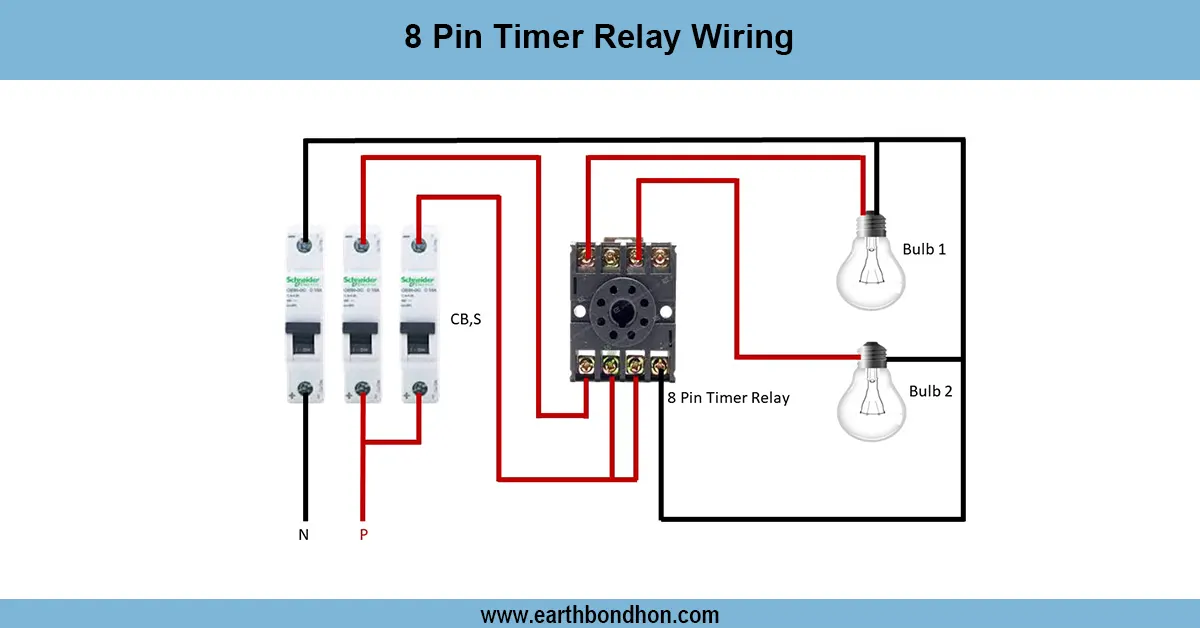
8 pin timer relay wiring

Learn the pin configuration and wiring method for an 8‑pin timer relay to control loads with a delay. Includes coil connections, NO/NC contacts, and timing logic.

ceiling fan switch and regulator wiring

This ceiling fan's speed controller wiring diagram demonstrates the connection of a regulator and a fan to facilitate smooth control of speed. The switchboard phase (live) wire traverses the speed controller (fan regulator) and then on to the fan, with the neutral conductor then being connected to the fan. This wiring provides the controller with the chance to regulate resistance or voltage in order to control the fan speed. The correct wiring diagram would point out the input phase to the regulator output to the fan, and the neutral to the fan connections. The correct installation will aid in preventing overheating and will also be energy-saving and extend the life of the fan. Modern electronic fan regulators have superior speed control over the traditional resistive regulators.

Work / Installation (Inputs → Outputs)

Under this type of wiring, the switching board input phase is connected to the speed controller. The controller has the output wire that goes to the fan phase terminal. The supply neutral makes a direct connection to the neutral connection of the fan. In this manner, upon rotation of the regulator knob, it alters the voltage or resistance to the fan, thereby regulating its speed. The old regulators are drop voltage-based based and the new electronic regulators are capacitor-based or triac-based based depending on which offer a continuous range of speed. Always offload the main supply during installation, use appropriate insulated wiring, and make tight terminal connections to prevent overheating and sparking.

Testing & Final Adjustments

Wire and turn on the main supply, then use the wall switch. Turn the speed controller knob to ensure that the fan is operating at varying speeds. Begin at minimum and work to maximum. Check the regulator output connections unless you start the fan at low speed. Make sure the controller does not make unusual noise, vibration, or overheat. Test the wall switch ON/OFF status to ensure total isolation of the circuit. Mark the switchboard so that it can be identified. When an electronic regulator is being used, ensure stepless regulation without pulsation. Lastly, check out the insulation, earthing, and tightness of the wires to prevent further risks.

Frequently Asked Questions - 8 Pin timer Relay wiring:

What is an 8‑pin timer relay?

A timer relay with coil, two common contacts each with NC and NO terminals.

Which pins are for the coil?

Pins 2 and 7 are used for the coil (L and N supply) on most models.

How are relay contacts arranged?

Pins 1 & 8 are COM; 1 NC‑4/NO‑3; 8 NC‑5/NO‑6 contacts.

Which pins are NO and NC?

Pin 3 & 6 are NO; pin 4 & 5 are NC relays.

Can the timer drive motors?

Yes, in auto ON/OFF circuits for motors using appropriate rating.

Is this a DPDT timer?

Yes, two separate poles each with NC/NO outputs.

What voltage is coil rated?

Common options: 12 VDC, 24 VDC, 110 VAC, or 220 VAC depending on model.

Can I wire it without a diagram?

It’s risky; pin numbering and logic vary—always follow manufacturer pinout.

Do I need MCB protection?

Yes—use a SP or DP MCB/RCCB rated for coil and load currents.

How do I use it for delay ON/OFF?

Apply coil voltage to start delay, contacts change after set duration.

Comments

Please login to comment.

Earth Bondhon

Earth Bondhon

Calculator Tools Project

Md. Jony Islam is a highly skilled professional with expertise in electronics, electrical, mechanical, and civil engineering, as well as finance. Specializing intransformer service and maintenance for 33/11kV substations, he ensures reliable and efficient electrical systems. His mechanical engineering skills drive innovative designs, while his financial acumen supports effective project budgeting. With a strong foundation in civil engineering, he contributes to robust infrastructure development. Md. Jony Islam's multidisciplinary approach ensures efficiency, quality, and reliability across all projects.