Creators
Md Jony Islam Author
Md Jony Islam
CalculatorToolsProjectExpert
Reviewers
Małgorzata Koperska, MD Steven Wooding
Last updated: January 14, 2026

3 Phase to Single Phase Sub Energy Meter Wiring Diagram Guide

🇺🇸
English
Default
🇪🇸
Español
Spanish
🇫🇷
Français
French
🇩🇪
Deutsch
German
3 Phase Energy Meter

3 Phase Energy Meter

Device to measure energy consumption in 3 phase

Single Phase Energy Meter

Single Phase Energy Meter

Device to measure energy consumption in single phase

3 Phase TP MCCB 100A

3 Phase TP MCCB 100A

Triple Pole Molded Case Circuit Breaker rated at 100 Amps

Single Phase DP MCB

Single Phase DP MCB

Double Pole Miniature Circuit Breaker for single-phase supply

*Please note: These are affiliate links. I may make a commission if you buy the components through these links. I would appreciate your support in this way!

3-phase to single-phase Sub Energy Meter Connection

Learn 3-phase to single-phase sub energy meter wiring, connections, protection, and accurate energy measurement for residential or commercial loads.
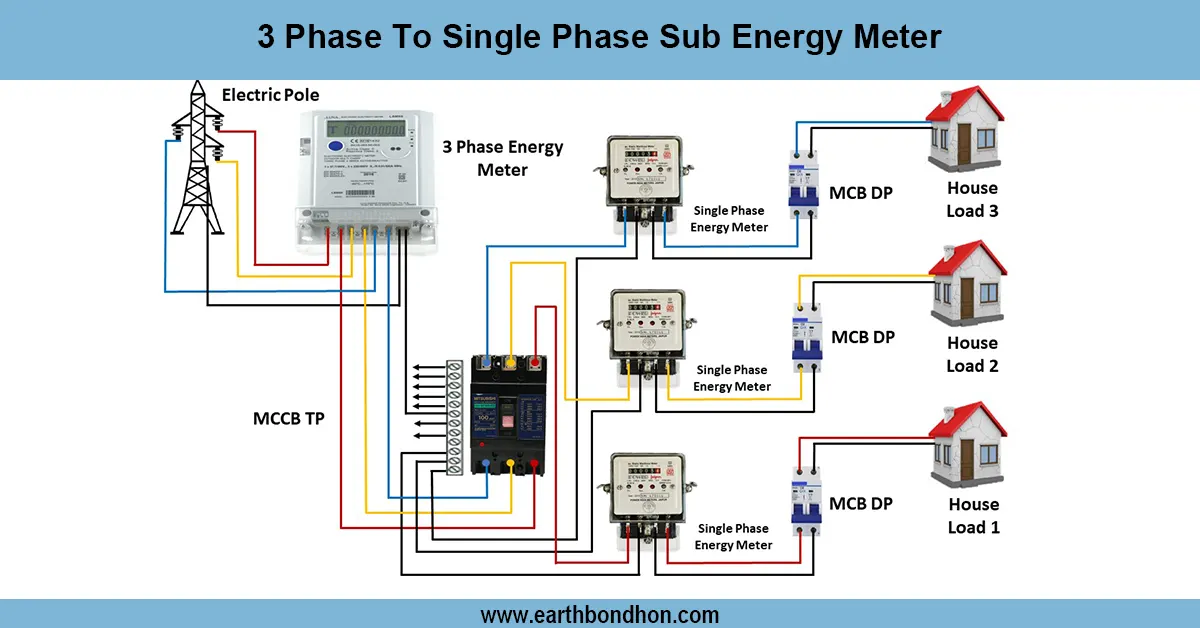
single phase energy meter from 3 phase:

A 3-phase to single-phase sub energy meter transforms 3-phase energy to single-phase, enabling proper monitoring of energy. Good wiring, protection, and load balancing are done to provide safe operation and good readings.

automatic transfer switch generator connection

State electric wiring also uses an Automatic Transfer Switch (ATS), which automatically switches the power supply during a power outage between the utility (main supply) and the generator (backup). This keeps the homes, commercial buildings, and industrial setups operating through electricity.
The ATS wiring consists of an MCB, contactors, generator input, utility input, and load connection. The load is connected to the main supply when the utility power is available, which is connected to the ATS. Once the utility goes out, the ATS will automatically switch to the generator supply. This system guarantees safe, reliable, and automatic transfer of load.
Correctly wired ATS with protection equipment such as RCCB, earthing, and circuit breakers provides the safety of equipment and protection to its users. It is also commonly found in residential apartments, hospitals, offices, and industries where constant power is essential.

Work / Installation (Inputs → Outputs)

Installation starts with connecting the main utility supply and the Generator supply to the ATS input terminals. The ATS has two inputs, one being the main supply and the other the backup generator. At the ATS is the load (house or building distribution panel), which is linked to the output.
The ATS maintains the load of the main supply when utility power is ON. In the event of power losses, it is the ATS that will trigger the generator to come on (in auto systems) and transfer the load to generator power. When utility power is back online, ATS automatically switches the load over to the main power again and de-energizes the generator.
This type of wiring system allows the automatic switching of electricity to be made safe and easy without any interruption.

Testing & Final Adjustments

Once installed, test the system by turning off the utility supply. The loss of power should also be recognized by the ATS, causing it to transfer the load to the generator and begin the spare supply in a matter of seconds. The ATS should reload the load when the main power goes back on.
Test all connections, earthing, and circuit breakers to ensure that they are working correctly. Ensure that the generator start/stop signal is functioning properly (when using auto-start). To ensure extra safety, check the RCCB to ensure leakage protection.
When possible, adjust the transfer delay to prevent false switching when there is a change in voltage. The ATS provides ongoing power, equipment protection, and comfort to the user with proper adjustments.

Frequently Asked Questions - 3-phase to single-phase Sub Energy Meter Connection:

What is a 3 phase to single phase sub energy meter?

A meter that measures single-phase energy from a 3-phase supply for specific loads.

Why use sub energy meter?

To monitor energy consumption of single-phase loads separately from main supply.

Which phases are selected?

Any two phases from 3-phase supply (R-Y, Y-B, or B-R) are chosen.

Is neutral connection required?

Yes, neutral is required for meter and load operation.

What protection devices are needed?

MCB or fuse to prevent overload and faults.

Can it be used in residential buildings?

Yes, commonly used for sub-metering apartments or offices.

How to verify meter reading accuracy?

Check voltage and load current, and compare with actual consumption.

Is earthing necessary?

Yes, for safety and correct meter operation.

Can multiple meters be installed on one 3-phase line?

Yes, with proper phase selection and protection for each meter.

How to test after installation?

Verify voltage, meter reading, protection devices, and load balance.

Comments

Please login to comment.

Md Jony Islam

Md Jony Islam

Calculator Tools Project

Founder of Earthbondhon.com

a free online tools website designed to make everyday and engineering-related calculations easier for students, professionals, and hobbyists. The site offers a wide range of basic calculators across key categories, including Electrical Calculators, Electronic Calculators, and Time & Date Calculators.