Heat-Sensitive Fan Using MOSFET Circuit
Learn to build a Heat-Sensitive Fan Using MOSFET Circuit with wiring diagram, components, working principle, step-by-step DIY guide, and troubleshooting tips.

What is a Heat-Sensitive Fan Using MOSFET Circuit?
A Heat-Sensitive Fan Circuit happens to be a mechanism that is capable of triggering a fan based on temperature changes. The MOSFET is used as a switch so that the fan is activated once the temperature reaches a certain limit. This means less manual operation in controlling the fans, overheating of the parts, and it is more economical in cooling applications.
Heat activated fan circuit
A Heat-Sensitive Fan Using a MOSFET Circuit is a simple circuit in electronics that automatically switches on a fan when the temperature around the fan goes beyond a given temperature. The switch in this project is a MOSFET, but operated under the control of a temperature sensor such as an NTC thermistor or an LM35 IC. The MOSFET is activated when heat is sensed, and it turns on the fan that cools efficiently without the need of being manual operation.
Here, we shall describe the principle of operation, the components needed, the circuit wiring, and a step-by-step procedure for assembling a circuit of a heat-sensitive fan. The project can be used by beginners and hobbyists with interests in the field of electronics because it offers them a hands-on experience on how to use MOSFETs to control loads and automate them based on temperature.
Components Required for the Circuit
- MOSFET (IRFZ44N or similar)
- Temperature Sensor (NTC Thermistor or LM35)
- Resistors (1kΩ – 10kΩ)
- Potentiometer (optional for adjustable threshold)
- DC Fan (5V–12V depending on MOSFET and sensor)
- Capacitors (10µF – 100µF for stabilization)
- Power supply (5V–12V DC)
- Breadboard, PCB, and connecting wires
Working Principle of Heat-Sensitive Fan
Role of MOSFET
MOSFET acts as an electronic switch. Gate voltage from the temperature sensor controls conduction. High gate voltage turns the fan ON, low voltage turns it OFF.
Temperature Sensor Operation
An NTC thermistor decreases resistance with increasing temperature. LM35 outputs a voltage proportional to temperature. Sensor signal determines MOSFET gate voltage.
Fan Control Mechanism
Fan remains OFF when the temperature is below the threshold. When the temperature rises, the sensor voltage triggers MOSFET. MOSFET conducts current to the fan, turning it ON.
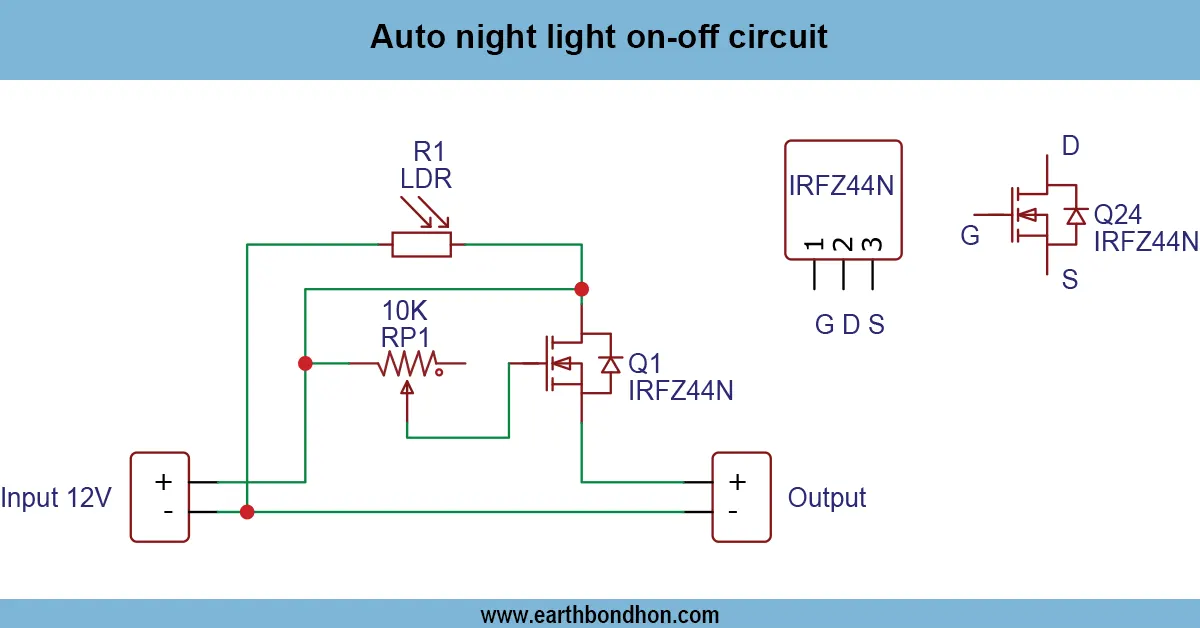
Heat-Sensitive Fan Using MOSFET Circuit Diagram
- Connect the MOSFET drain to the fan's negative terminal.
- Connect MOSFET source to ground.
- Fan positive terminal goes to the power supply positive.
- Connect the temperature sensor output to the MOSFET gate through a resistor.
- Add a capacitor for voltage stabilization if required.
- Test the circuit by heating the sensor or adjusting the potentiometer.
Step-by-Step DIY Construction Guide
- Mount MOSFET and temperature sensor on breadboard or PCB.
- Connect sensor output to MOSFET gate through a resistor.
- Connect the fan between the MOSFET drain and the positive power supply.
- Connect MOSFET source to ground.
- Apply DC power and test by varying the temperature.
- Adjust potentiometer or resistor to set temperature threshold.
- Secure components and ensure proper insulation.
Applications of Heat-Sensitive Fan Circuit
- Automatic PC or electronics cooling
- Solar panel or battery cooling
- Greenhouse or room temperature-controlled fan
- DIY electronics cooling projects
- Temperature-based fan automation
Troubleshooting Common Issues
Fan Not Turning On
- Check MOSFET gate voltage.
- Verify power supply voltage.
Fan Running Continuously
- MOSFET may always be conducting.
- Check gate resistor and sensor wiring.
MOSFET Overheating
- Ensure MOSFET current rating is sufficient.
- Add a heat sink if required.