

Operate 2 Motor From 3 Places
Learn how to control two motors from three locations using interlocked switches, ensuring safe operation, easy control, and proper ON/OFF sequences.
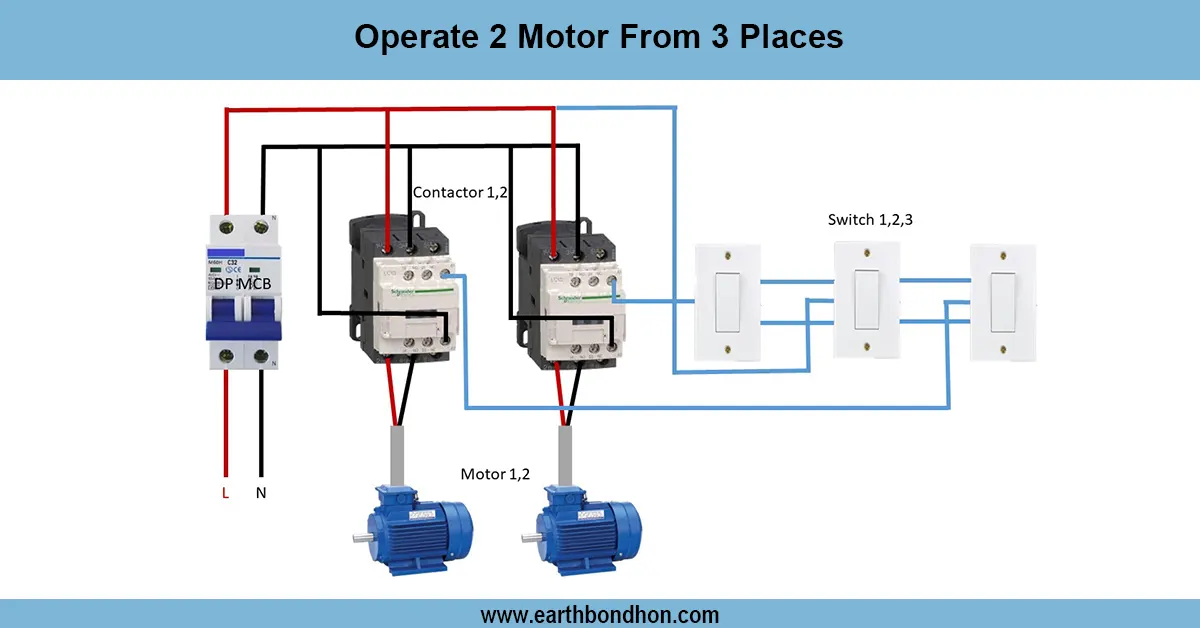
two motors from multiple switches
Interlocked switches and contactors have to be made to allow two motors to be controlled by three locations. When using in the industrial or workshop environment, the three points allow each individual motor to be controlled separately, making the operations flexible and safe.
multiple switch motor control
The interlocked switches, contactors, and overload protection must be used to operate two motors at three locations. The motor is mounted on a contactor, and the ON/ OFF switches at each spot are connected to the contactors. The interlocking is whereby the two motors cannot be switched on accidentally, when not meant to be. The three are controlled by the use of push buttons or toggle switches, which allow control at the various points. The neutral and earth connections should also be much-properly connected. This construction is common in industrial workshops, conveyors, and large machines, where there are many operators who are required to control motors remotely. Testing is done to ensure that every motor is correctly responding in terms of switches at all three points, and also to make sure that the interlocks do not allow unsafe operation. Proper installation will guarantee safe, dependable, and flexible control of the motors.
Work & Installation (Input → Output Summary)
- Connectmain supply to the contactor inputsof both motors.
- WireON/OFF switches at three locations to control each motor's contactor coil.
- Includemechanical or electrical interlocks to prevent simultaneous unsafe operation.
- Connect motors to thecontactor outputs.
- Ensure properneutral and earth connections.
- Test all switches from all three locations to verify correct operation and interlocking.
Testing & Final Adjustments
- Verify wiring: supply, contactor coils, switches at all locations, motors, neutral, and earth.
- Test each motor from each switch location for proper ON/OFF operation.
- Confirm interlocks prevent simultaneous unsafe activation.
- Inspect neutral and earth continuity for safety.
- Ensure overload protection is connected and functional.
- Perform multiple cycles to verify repeatable operation.
- Label switches and motor circuits for clarity.
- Check for loose or exposed wires and mechanical issues.
- Confirm that switching at one location reflects correctly at all others.
- Document wiring diagram and test results for future reference.