
Creators
Md Jony Islam Author
Md Jony Islam
CalculatorToolsProjectExpert
Reviewers
Małgorzata Koperska, MD Steven Wooding
Last updated: January 14, 2026

Complete House Motion Sensor Wiring Diagram and Sensor Connection

🇺🇸
English
Default
🇪🇸
Español
Spanish
🇫🇷
Français
French
🇩🇪
Deutsch
German
Single Phase DP MCB

Single Phase DP MCB

Double Pole Miniature Circuit Breaker for single-phase supply

Motion Sensor

Motion Sensor 220V

Device that detects movement using infrared or ultrasonic signals

2 Way Switch

2 Way Switch

A switch that controls one device from two locations

Single phase Light

Single Phase LED Light

Energy-efficient LED light for single-phase supply

Single Phase Tube Light

Single Phase Tube Light

A switch that controls one device from two locations

*Please note: These are affiliate links. I may make a commission if you buy the components through these links. I would appreciate your support in this way!

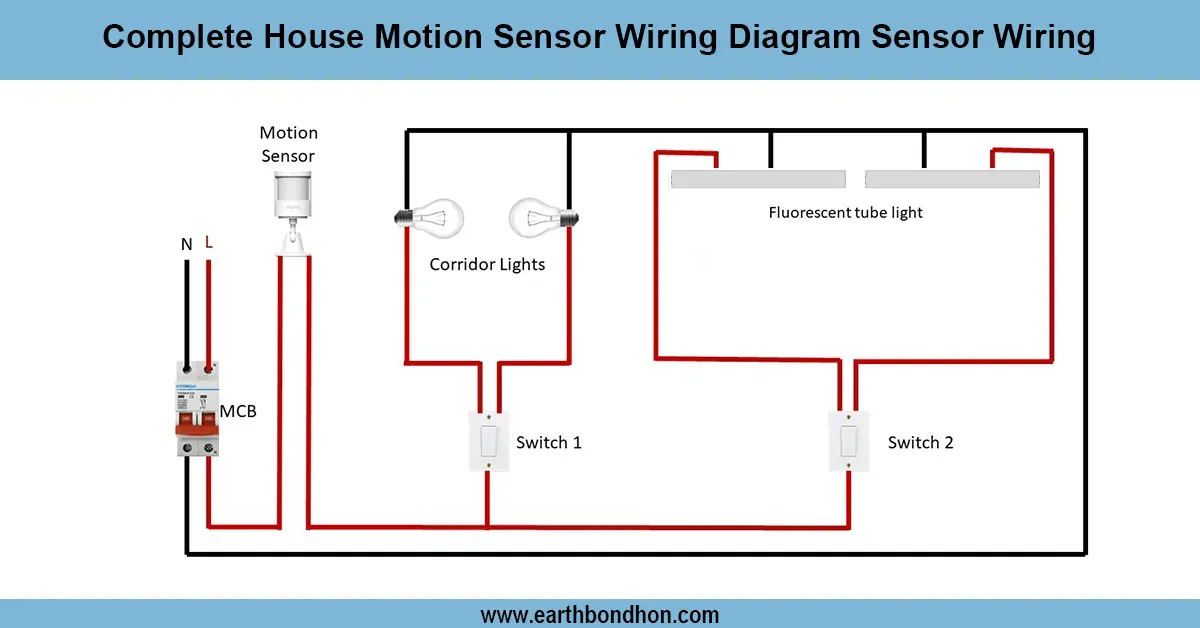
Pir Motion Sensor Light Wiring Diagram

Learn complete house motion sensor wiring for lights and alarms, including sensor connections, power supply, and safe operation for automated home control.
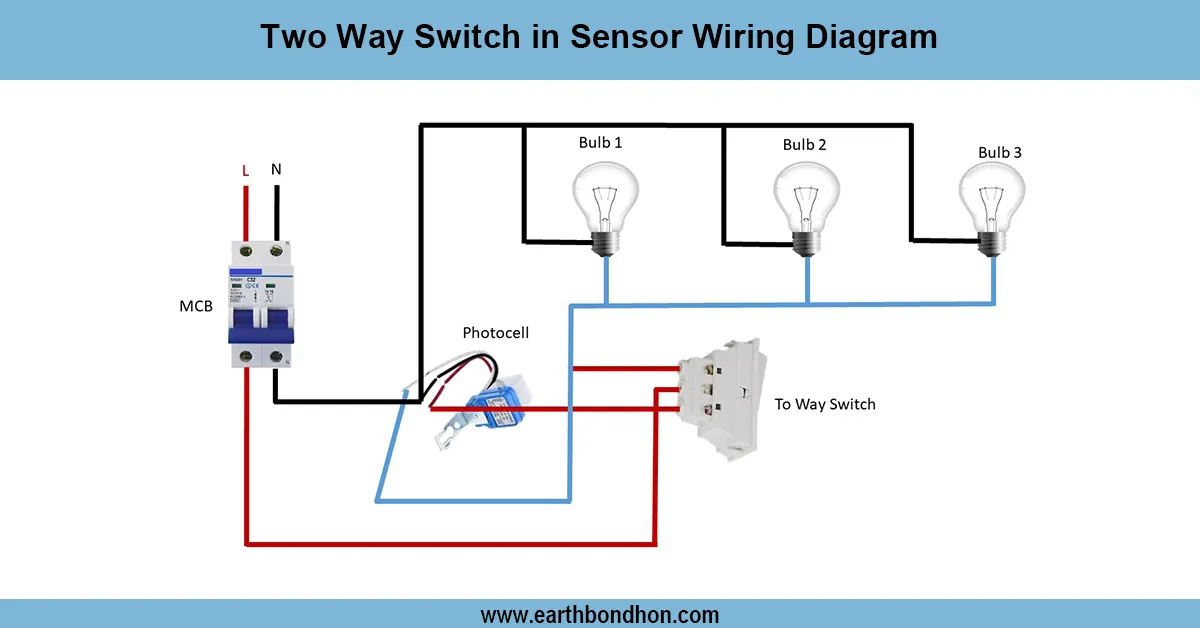
automatic light sensor connection

The House motion sensor wiring system is an automatic system that operates lights and alarms by motion sensor. Correct wiring will guarantee the stability, security, and eco-friendliness of functioning.

motor on delay contactor wiring

A delay timer control in contactor wiring is a handy automation configuration to delay a load switch-on after coming on.
The timer on the delay switches on only after a predetermined delay, and this delay is then utilized to switch the contactor coil (A1–A2). This is used to guarantee that the load connected, motors, pumps, fans, or HVAC system do not start with a sudden inrush current or unwanted starting.
The timer is fed in this type of wiring. When it is fed with an input signal, the timer counts its delay preset. Once this time has passed, it activates the output relay in order to provide power to the contactor coil. The contactor then closes its main contacts, and the power is connected to the load.
This is needed in the automation of industries, including motor protection, pump sequencing, and generators with staggered or delayed starts to avoid overloading the system. Safety and reliability can be obtained through proper usage of MCB/RCCB, earth connections, and control fuses.

Work / Installation (Inputs → Outputs)

Input: Supply → MCB/RCCB → On Delay Timer.

  • Feed phase and neutral to the timer’s input.
  • Set the required delay time on the timer (seconds/minutes).
  • Connect the timer’s relay output to A1 of the contactor coil, and connect A2 to neutral.
  • Pass the main phase through the contactor’s input (L1, L2, L3) and take the output from T1, T2, T3. For single-phase, use one pole.
  • Connect neutral directly to the load (or via 2-pole contactor if needed).
  • Bond earth properly to load and metal parts.

Output: When power is supplied, the timer waits for the preset time, then energizes the contactor coil, which connects the load.

Testing & Final Adjustments

Install and set the on delay timer to use a short test delay (e.g., 5 seconds). Turn ON the supply and monitor: the timer must await the programmed time before activating the contactor coil. Check the voltage at A1- A2 at ON. Ensure that the load does not begin before the delay.
Check the operation of the MCB/RCCB and the proper phase/neutral connections polarity. Measure load current to ensure that there is no direct inrush at start. Set the timer delay to the required value to suit your application (longer delay required with sequential pumps).
Install ferrules, screw on terminals, and stitch wiring. Apply a small fuse in the control circuit and surge protection to the coil to protect to system's life. After testing, label the wiring to make it easy to troubleshoot.
This guarantees the safe, efficient, and reliable delayed start control in pumps, motors, lighting, or HVAC systems.

Frequently Asked Questions - Pir Motion Sensor Light Wiring Diagram:

What is a motion sensor?

A device that detects movement and activates lights, alarms, or other devices.

How is it wired in a house?

Connect live, neutral, and earth to the sensor and output to the load.

Can multiple sensors control one light?

Yes, sensors can be wired in parallel to control a single load.

Is earth connection necessary?

Yes, for safety and reliable operation.

How to prevent false triggering?

Adjust sensitivity and avoid mounting near heat sources or air vents.

Can I add a manual switch?

Yes, a manual override can be added in series with the load.

What loads can be controlled?

Lights, alarms, relays, fans, or other electrical devices.

Do I need fuse or MCB protection?

Yes, to protect the sensor and connected devices.

Where should sensors be mounted?

Entrances, corridors, driveways, or areas with motion detection needs.

How to test a motion sensor?

Power on, move in the detection area, and observe activation of connected load.

Comments

Please login to comment.

Md Jony Islam

Md Jony Islam

Calculator Tools Project

Founder of Earthbondhon.com

a free online tools website designed to make everyday and engineering-related calculations easier for students, professionals, and hobbyists. The site offers a wide range of basic calculators across key categories, including Electrical Calculators, Electronic Calculators, and Time & Date Calculators.