Creators
Md Jony Islam Author
Md Jony Islam
CalculatorToolsProjectExpert
Reviewers
Małgorzata Koperska, MD Steven Wooding
Last updated: January 14, 2026

Selector Switch in Voltmeter Wiring Diagram and Connection Guide

🇺🇸
English
Default
🇪🇸
Español
Spanish
🇫🇷
Français
French
🇩🇪
Deutsch
German
3 Phase TP MCB 32A

3 Phase TP MCB 32A

Triple Pole Miniature Circuit Breaker

Single Phase 2-Position Selector Switch

Single Phase 2-Position Selector Switch

Three-phase electric motor with 2 horsepower

single-Phase Voltage Meter

single-Phase Voltage Meter

Device that measures and displays voltage in a single-phase electrical system

*Please note: These are affiliate links. I may make a commission if you buy the components through these links. I would appreciate your support in this way!

Voltmeter Connection in 3-phase Wiring

Learn how to wire a selector switch with a voltmeter to measure multiple points safely, including AC/DC circuits, connections, and protection.
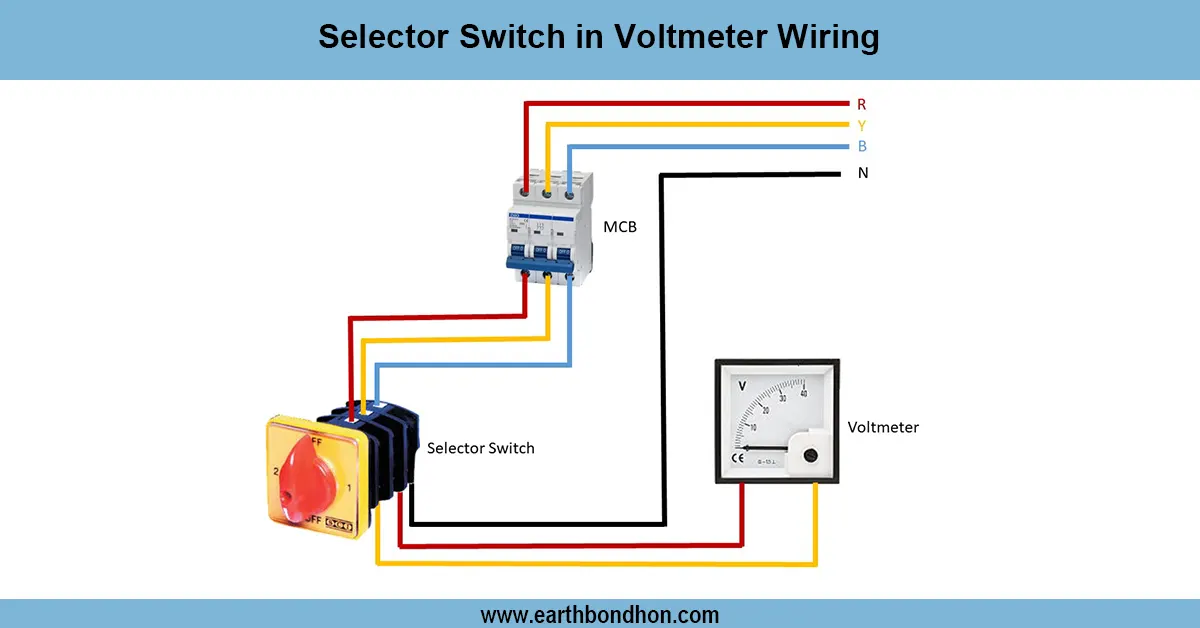
multi-point voltmeter connection

A SDB (Sub Distribution Board) is a safe distribution of electricity to various circuits through MCBs, RCCBs, and busbars, which provides a secure distribution of electricity as well as management of loads and backup operational stability.

single phase motor protector wiring diagram:

A Motor protector with a single-phase motor is used to ensure safe usage and also to protect against overloading or short-circuiting. An isolation and protection between the incoming and neutral is joined up with a DP switch or MCB. Motor supply/ starter coil: To detect current and cut off in case of overload, the motor protector is wired in series with the motor supply/starter coil. The installation acts as a normal operation of the motor when it has to work under safe conditions, and the shutdown of the power in case of unsafe conditions. The earthing is necessary to enhance safety. The wiring design depicts the connection of the DP switch/MCB and motor protector, motor terminals, and a starter coil or push buttons. The system is applied extensively in pumps, fans, and appliance machinery, which gives it good reliability, automatic protection, and easy maintenance. Correct installation eliminates electrical faults, provides a longer life of the motor, and enhances the safety of the operators.

Work & Installation (Input → Output,)

  • Input Supply: Phase and neutral from main line.
  • DP Switch / MCB: Provides isolation and short circuit/overload protection.
  • Motor Protector: Connected in series with motor supply or starter coil; trips automatically on overcurrent.
  • Motor Terminals: Connected to the output of the motor protector/starter as per the diagram.
  • Control (Optional): Start/stop push buttons or a timer can control the starter coil.
  • Earthing:Earthing: Motor frame, protector, starter, and DP switch grounded properly.
  • Output: Motor operates normally under safe conditions; protector disconnects power if overload occurs, preventing motor damage.

This is a good arrangement to provide reliable motor operation, automatic protection against overloads, and safe working conditions.

Testing & Final Adjustments

Once wiring is complete, make sure that connections are tight and insulated. ESW switch/MCB on and ensure that the motor is running under normal load. Test overload: Temporarily load a motor by adding a load or by a testing device to make sure that the motor protector is functioning properly. Efforts: ensure that the motor gets turned off upon the functioning of the protector. Measure voltage at motor terminals (app. 220 V -240 V) and look at earthing issues. Make sure that there is a good connection between any coil of a starter, push buttons, or timer, and the protector. Fasten loose connections, label the DP switch, motor protector, starter, and terminal of the motor to identify them easily. Test insulation, motor windings, and control wiring to make sure there are no short circuits and bare terminals. Testing ensures the safety of operation, protection of the motor, and elimination of electrical hazards and prolongs the life period of the motor, as well as enhances reliability.

Frequently Asked Questions - Voltmeter Connection in 3-phase Wiring:

What is a selector switch in voltmeter wiring?

A switch that allows one voltmeter to measure voltage from multiple points.

Can it be used for AC and DC?

Yes, but each line should be labeled and within voltmeter range.

Is protection needed?

Yes, fuses or MCBs prevent overload and accidental short circuits.

How is it connected?

Each voltage point goes to a switch terminal, and the common terminal goes to voltmeter.

Can multiple voltmeters be used?

Yes, but the selector switch setup reduces cost and panel space.

How to test wiring?

Check each switch position for correct voltage reading and continuity.

Can switch positions overlap?

No, each position must be isolated to prevent short circuits.

Is insulation important?

Yes, to prevent electric shock and accidental contact between lines.

Can I use this at home?

Yes, for monitoring multiple circuits with one voltmeter safely.

How to label lines?

Indicate AC or DC voltage and the measurement point for clarity.

Comments

Please login to comment.

Md Jony Islam

Md Jony Islam

Calculator Tools Project

Founder of Earthbondhon.com

a free online tools website designed to make everyday and engineering-related calculations easier for students, professionals, and hobbyists. The site offers a wide range of basic calculators across key categories, including Electrical Calculators, Electronic Calculators, and Time & Date Calculators.