Automatic Timer Switch for Motor
Learn PB Series timer wiring to control motors with ON/OFF delay using push buttons, contactors, and proper neutral/earth connections for safe operation.
automation motor timer circuit
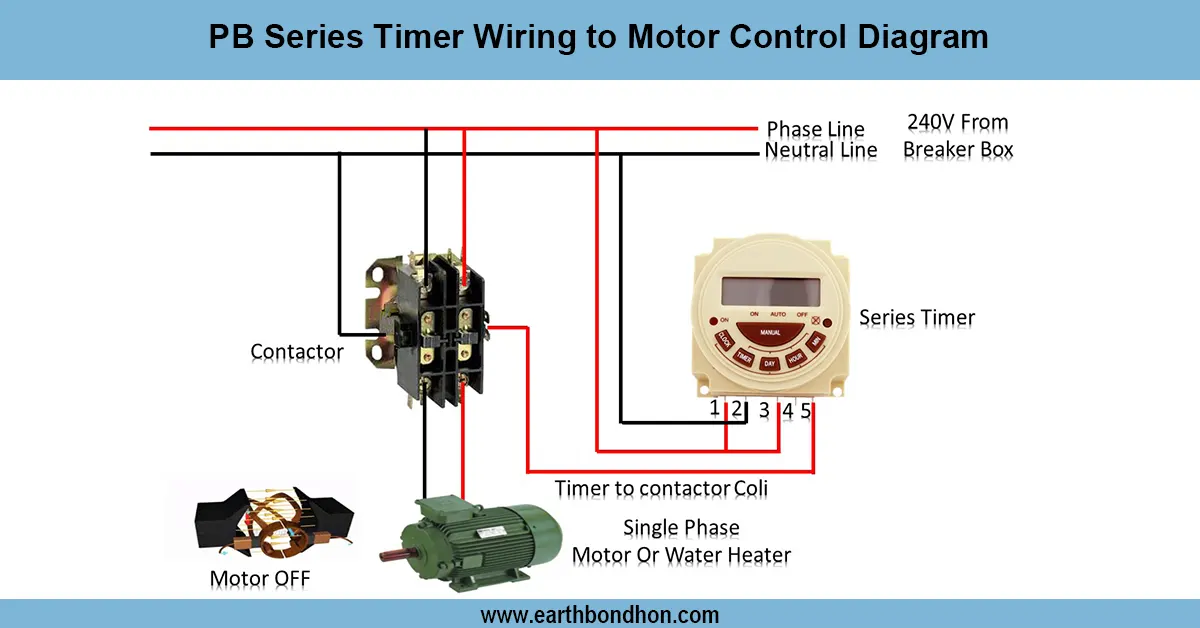
PB Series: timer wiring to motor control has the ability to switch ON or OFF with a push button and contactor, in a delayed manner. It provides good motor functioning and precludes mechanical or electrical strain.
industrial timer motor control
PB Series timer wiring enables a motor to be regulated with accuracy in the ON/ OFF delay. A push button (PB) is used to energize the timer coil, and when the delay elapses, a contactor coil is excited. The supply of the motor is regulated by the timer output contacts. This configuration may incorporate ON-delay, OFF-delay, or cyclic timing based on the PB timer model. Neutral and earth connections should be properly made. It is often employed in industrial applications to provide motor delayed start, sequential operations, and automation in the circuit. The testing is to push the push button, check that the contactor switches on the motor after the pre-set delay, and that the OFF-delay is correct in case of its setting. Proper installation will help avoid mechanical stress of the motor, promote smooth functioning, and offer a stable timed solution of control.
Work & Installation (Input → Output Summary)
- ConnectAC supply to PB timer input.
- Connectpush button (PB) in series with the timer coil.
- Connecttimer output contacts to the contactor coil.
- Connect themotor to the contactor output terminals.
- Set the desiredON-delay or OFF-delay on the PB timer.
- Ensure properneutral and earth connections.
- Press the PB; the timer controls motor switching according to the set delay.
Testing & Final Adjustments
- Verify wiring: AC supply, PB timer, push button, contactor coil, motor, neutral, and earth.
- Press the push button and observe motor activation after the preset delay.
- Test OFF-delay if configured by observing motor deactivation timing.
- Adjust timer settings for accurate delay duration.
- Check neutral and earth connections for safety.
- Perform multiple ON/OFF cycles to confirm reliable operation.
- Inspect for loose wires or exposed conductors.
- Confirm the contactor operates correctly with the timer output.
- Ensure motor rating matches contactor and timer capacity.
- Document wiring and timer settings for future reference.