

socket and switch for house wiring
Learn how to connect a switch with 2-pin and 3-pin sockets. Phase goes through the switch, Neutral directly to socket, and Earth to the 3-pin socket.
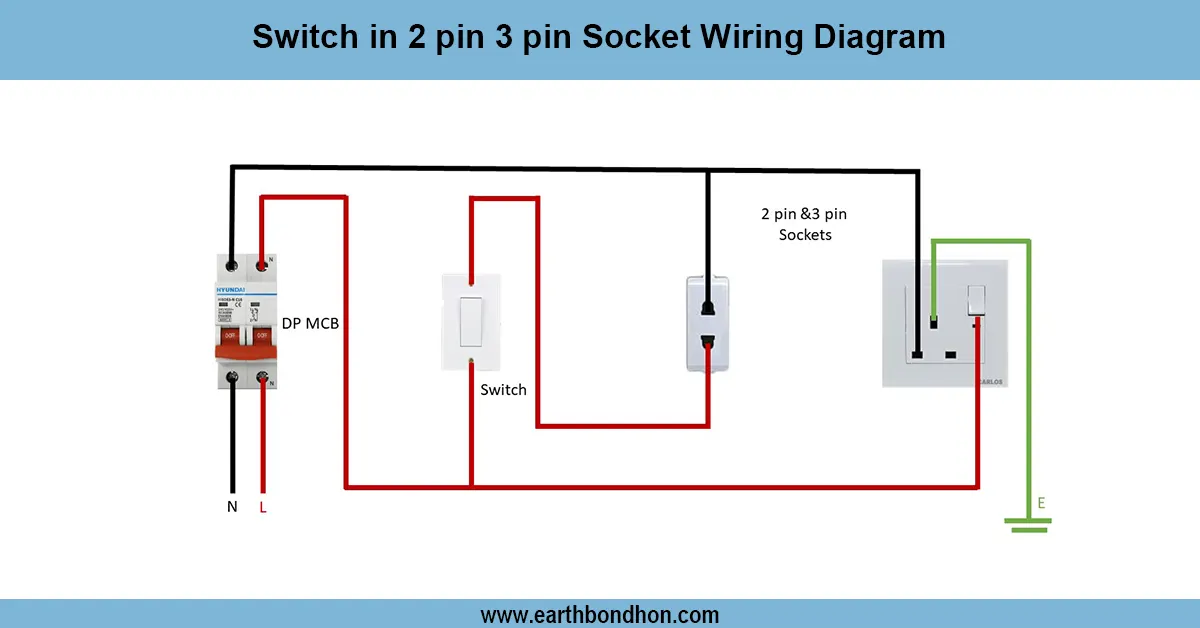
2 pin socket wiring with switch
In 2-pin and 3-pin socket wiring, the Phase wire is connected through a switch to the socket, Neutral goes directly to the socket, and Earth connects only in the 3-pin socket.
3 pin socket wiring with switch
A 2-pin and 3-pin socket wiring with switch is a common household connection. The principle is simple: the Phase (Line) wire is always connected through the switch before reaching the socket, so when the switch is OFF, the socket is disconnected from the supply. The Neutral wire connects directly to the socket’s Neutral terminal. In case of a 3-pin socket, an additional Earth wire is connected to the Earth terminal (usually the upper pin).
- 2-Pin Socket: Phase → Switch → Socket Live terminal, Neutral → Socket Neutral terminal.
- 3-Pin Socket: Phase → Switch → Socket Live terminal, Neutral → Socket Neutral terminal, Earth → Earth terminal.
This setup ensures safety: switching OFF cuts power only from the Phase side while Neutral and Earth remain fixed. It is important for appliances like mobile chargers, TVs, refrigerators, and irons.
Work / Installation (Inputs → Outputs)
2-Pin Socket
- Input: Phase → Switch → Socket Live terminal
- Neutral: Direct → Socket Neutral terminal
3-Pin Socket
- Input: Phase → Switch → Socket Live terminal
- Neutral: Direct → Socket Neutral terminal
- Earth: Direct → Socket Earth terminal
Testing and Final Adjustments
You may either turn ON the main supply and test using a tester or plug after wiring. Insert 2-pin plug: the attached device must be able to turn on only when the switch is pressed. In a 3-pin plug, the Earth pin has to be tested by continuity - a tester has to be connected between the Earth and the Neutral to check correct earthing. Should the socket fail, re-examine that the Phase is properly fed through the switch and that the Neutral is hard-wired. Do not connect Phase to anything without a switch because it is unsafe. Always code the correct wire color: red/brown phase, black/blue N, and green/yellow E. Lastly, cover up any exposed joints and screw tighten socket screws.